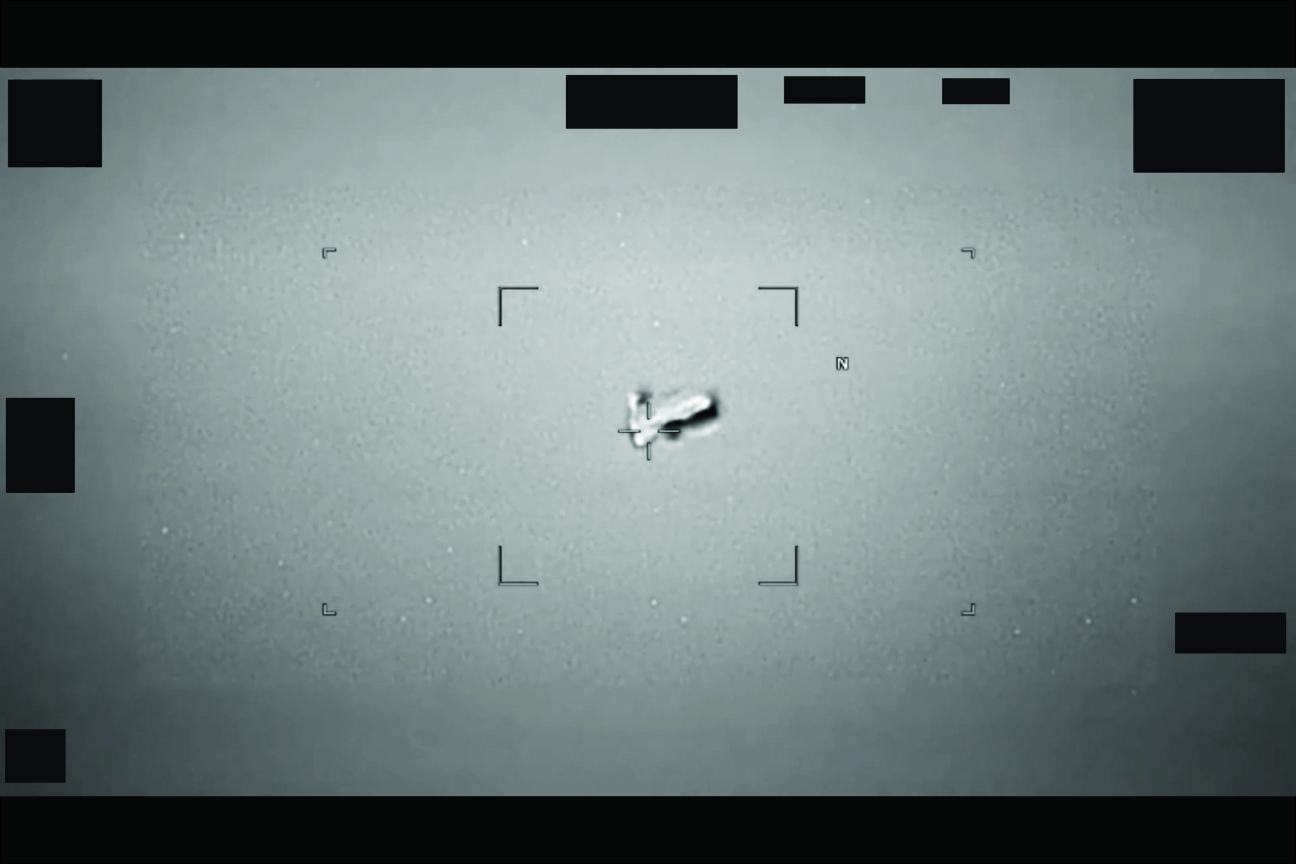
David Grusch told the House Oversight Committee in July 2023 that the U.S. government had retrieved non-human craft and biological material. That testimony — delivered under oath, to Congress, by a credentialed intelligence officer — is the highest-quality evidence the UAP disclosure movement currently holds. Everything else in the current information environment sits at a considerable distance from that standard.
That distance matters, because the volume of claims being generated right now is extraordinary. And when you trace who is making them, a pattern emerges that no one covering this beat has quite stated plainly: a significant portion of the current UAP disclosure narrative is being assembled by a small, interlocking content ecosystem — one that recycles sources across programs, conflates unverified testimony with official record, and rarely acknowledges when its central claims contradict each other.
This is not a conspiracy. It is a source problem.
The hub and its spokes
At the center of that ecosystem sits Dr. Michael Salla, who runs the website Exopolitics.org and produces a regular video program, Exopolitics Today. In recent weeks alone, Salla has published interviews with a man named Jorge Pabon — whom he describes as a military experiencer — about face-to-face encounters with Nordic extraterrestrials near Pabon's home; with Tony Rodrigues, who claims to have been introduced to remote viewing as a child and to have participated in secret space operations; and with a podcast host identified only as Michael from Conflict Radio, who says he met a woman claiming to be Amy Eskridge during a late-night encounter.
Amy Eskridge is significant. She was, by public record, the head of the Institute for Exotic Science in Huntsville, Alabama, and an advocate for antigravity research. Public reports state that she died in June 2022 from a self-inflicted gunshot wound. Salla's commentary, published on Exopolitics.org in June 2026, reported that his source — a person Salla says he has known for several years — claimed to have twice met a woman who identified herself as Eskridge and who looked very much like her. That woman allegedly described an underground facility beneath Green Mountain, near Redstone Arsenal and NASA's Marshall Space Flight Center, containing advanced spacecraft, Nordic extraterrestrials, international military pilots, and a functioning portal.
Public reports state that she died in June 2022 from a self-inflicted gunshot wound.
Salla himself offers three possible explanations for the account: the information is genuine, it is part of a psychological operation, or it was wholly fabricated by his source. That is responsible framing. What is less responsible is the volume and velocity with which these claims are then republished — across the UFOs-Disclosure blog network, across YouTube, and into a broader information ecosystem that strips away Salla's hedges in the retelling.
A separate remote-viewing session, conducted by Tony Rodrigues with three independent viewers, reportedly described an underground base at Green Mountain containing extraterrestrial technology and a dark-haired woman overseeing operations. That remote-viewing claim is then cited in subsequent coverage as corroborating the Eskridge account. Two unverified sources are being used to verify each other.
This is the structure. Claim A cites witness testimony. Claim B cites a remote-viewing session. Both point to the same location. Neither has a primary document behind it. Neither has drawn an official response. And both originate in the same content network.
Where the credible evidence actually sits
Contrast that structure with the one document in this landscape that carries genuine evidentiary weight: the CIA UAP D001 Intelligence Information Report, released through war.gov as part of the Department of War's UFO file releases. The document — a declassified CIA intelligence report bearing the file number FIR K-311/01638-77 and covering the period from November 1972 to November 1973 — describes a former Soviet citizen's account of observing an unidentified aerial phenomenon at Site 7 of the Sary Shagan Weapons Testing Range. The source, acquired in Germany, described stepping outside during a televised Canada-USSR sports event and observing a sharp green circular object or mass in the sky to the west, at an angle of approximately 70 degrees. Within ten to fifteen seconds, the green circle widened, and several green concentric circles formed around it. There was no sound. The source had no opinion as to what the phenomenon was.
This is a single, historically specific account. The CIA's own language in the document is careful: it is described as an information report, not finally evaluated intelligence. The source is a former Soviet citizen. The sighting is never explained. But the document exists, carries an official classification history, and was released through a government channel. That is categorically different from a late-night encounter with a woman who may or may not be a scientist the public record says died four years ago.
The third release of the Department of War's UFO files became available in mid-June 2026, one day after the release of a film called Disclosure Day, according to Salla's Exopolitics Today program. The timing is noted in Salla's coverage without further investigation into whether it was deliberate or coincidental. MSN separately reported on U.S. government UAP file releases alongside sightings of a mystery jet near Area 51. Neither story has produced primary document confirmation of the specific claims being made in the broader disclosure ecosystem.
Rear Admiral Tim Gallaudet, the former Oceanographer of the Navy and head of NOAA, occupies a different tier. He is a named, credentialed official who has publicly argued — in a white paper for the Sol Foundation titled Beneath the Surface — that the Department of Defense holds a classified folder of sensor data showing unidentified submersible objects interacting with U.S. nuclear submarines. That is a serious, attributable claim from a named source with relevant expertise. His contention that the Southern California Bight has been a high-traffic zone for transmedium craft is on record. The sonar data he says would confirm this has not been released.
The difference between Gallaudet and the other figures in this landscape is accountability. He has put his name and his professional reputation on specific, falsifiable claims. The question of whether those claims are true remains open. But the claims are traceable.
The contradictions no one is resolving
Two tensions in the current coverage deserve explicit attention because they are being papered over rather than reported.
First: the Venezuela enriched uranium story. Salla's Exopolitics Today program raised the question of whether the U.S. Department of Energy's removal of enriched uranium from Venezuela was actually a cover for the removal of ancient technology recently discovered in Venezuelan jungles. The premise requires accepting simultaneously that the uranium removal happened as reported — which it did, per the program's own framing — and that it was a cover for something else entirely. These are not complementary claims. They are in tension, and the tension is not resolved in the coverage.
Second: the composition of the UAP Science Advisory Council. Salla's program reported that the council, associated with Harvard astrophysicist Avi Loeb, lacks a political scientist — a notable gap for a body that would presumably need to reason about geopolitical consequences of disclosure. Separately, the same program notes that skeptic Michael Shermer is among the council's members. Whether the council's composition is adequate to its mandate is a legitimate question. But the framing shifts between these two data points without settling on what, exactly, is being argued.
What emerges from all of this is not evidence of extraterrestrial life, or of a government cover-up, or of underground spaceports. What emerges is a content ecosystem that is outpacing the evidence it claims to represent — generating claims faster than they can be checked, amplifying unverified testimony by looping it back through affiliated programs, and occasionally producing genuine sparks of documented history alongside material that cannot be verified at all.
The specific development that would change this picture is straightforward: a congressional response to the CIA records demand over the 1996 Varginha incident. Lawmakers are reportedly pressing the CIA to release files related to that case. If those files exist and are produced, they would represent the kind of primary document that the current wave of disclosure claims almost entirely lacks. Until then, the sourcing problem is the story.