Avi Loeb was sitting for an interview when he offered his philosophy on the work. "It's like a detective story," he said. "It's a lot of fun, as long as you don't pay too much attention to the critics."
The critics, it turns out, are not easy to ignore.
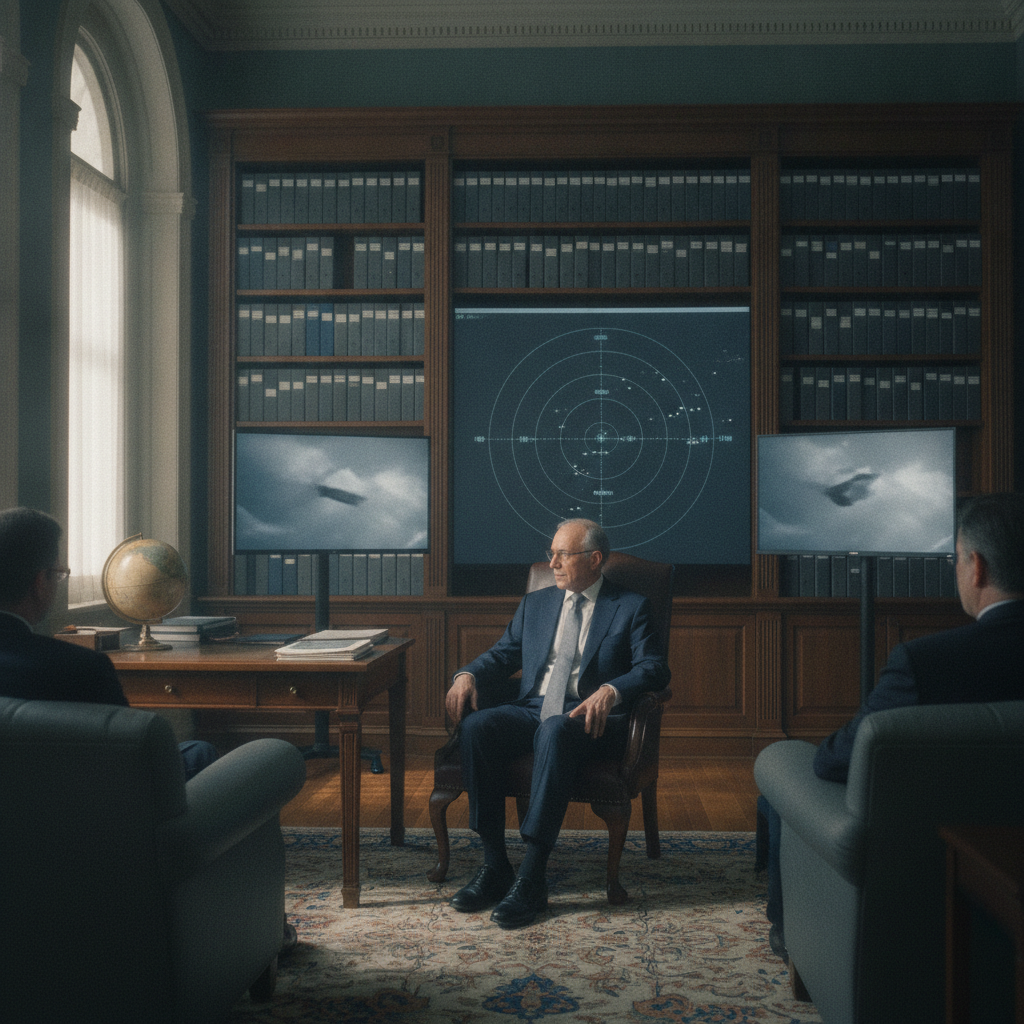
The White House recently appointed Loeb, a cosmologist who chaired Harvard's astronomy department until 2020, to lead a new scientific advisory council tasked with studying the national security implications of unidentified aerial phenomena. According to the Associated Press, reported by Collin Binkley and published through PBS NewsHour on June 30, 2026, Loeb's council will report to a UAP Governance Board overseen by the Office of the Director of National Intelligence — itself created in response to a directive from President Donald Trump calling for greater transparency on UFOs and alien life. The board met for the first time in June.
The appointment is the clearest signal yet of how the current administration intends to shape the disclosure story — and the choice of Loeb says something important about what that shape might look like.
A polarizing pick at a pivotal moment
Loeb's trajectory into this role is worth tracing carefully, because the path reveals the tensions inside the entire disclosure enterprise.
His public profile shifted in 2017 when an interstellar object passed through the solar system. While other scientists proposed it was a comet or chunk of ice, Loeb argued it could be a thin light sail detached from an alien spacecraft. The claim made headlines. It also made enemies in his field. Other astronomers, the AP reported, accused him of making exotic claims with little evidence and bypassing peer review to take those claims directly to the public. He went on to found the Galileo Project at Harvard, with a stated mission to search for artifacts from alien civilizations. In 2023, his team retrieved hundreds of small metallic spherules from the Pacific Ocean floor, near the suspected impact site of a 2014 meteor. Loeb suggested they might have originated from a distant planet or from alien technology. Other scholars said they were more likely volcanic rock or coal ash.
Sean Kirkpatrick, the physicist who previously led the Pentagon's All-domain Anomaly Resolution Office — better known as AARO — told the AP that Loeb is "not viewed favorably" in the scientific community and lacks national security experience. Kirkpatrick suggested the composition of Loeb's team indicated the White House was more interested in fringe theories than hard science. The White House did not respond to the AP's request for comment on that criticism.
Loeb himself is unbothered, at least publicly. He says he is approaching the UAP question first from a national security perspective, starting with the assumption that the objects are human-made. "Let's keep our eyes on the orbs," he told the AP, "not the social media."
His hand-picked council includes more than a dozen scientists and UAP activists, along with Timothy Gallaudet, a retired rear admiral who has claimed the United States has recovered crashed aircraft and warned about UAP controlled by nonhuman intelligence. Also on the council is Ben Lamm, a billionaire entrepreneur. After the group's first meeting, it sent a request to the Pentagon for more than 50 videos, images, and other documents related to known UAP incidents. According to the AP, Loeb's council meets behind closed doors, though he has said he will brief the public and create a website to share findings.
Steve Desch, an astrophysicist at Arizona State University, was direct about his concerns. "I don't know what's going to come of this," he told the AP, "but we're not going to get any closer to answering these questions with him in charge."
"I don't know what's going to come of this"
That tension — between credentialed skepticism and credentialed enthusiasm — runs through the entire disclosure apparatus right now.
What the structure actually looks like
Understanding the institutional architecture matters here, because the Loeb council is only one layer.
Below the UAP Governance Board and Loeb's advisory council sits AARO, the Pentagon's investigative office. AARO's caseload has now exceeded 2,000 reported incidents, according to DefenseScoop, and Defense Secretary Pete Hegseth has publicly reaffirmed Trump's disclosure promise. AARO has officially stated it has seen no evidence of alien life — a position that puts it in direct tension with some of the people now advising the White House on UAP.
Meanwhile, on Capitol Hill, the momentum is real and documented. Representative Luna opened a House hearing in September 2025 explicitly focused on restoring public trust through UAP transparency. A UAP Disclosure Forum convened in the U.S. Senate in late June 2026, drawing UFO experts and lawmakers together on Capitol Hill. Avi Loeb wrote about attending it on Medium. Ross Coulthart and Meagan Medick broadcast live from NewsNation's Washington studio immediately after the forum. The event was organized, attended by named members of Congress, and covered by credentialed journalists. That is not nothing.
Also worth noting: David Grusch, the former intelligence official whose 2023 congressional testimony set much of this in motion, has said he has seen classified photographs of UFO crash retrievals involving differently shaped craft and is now calling for those images to be declassified. That is a significant escalation from testimony to a specific, named demand.
But the picture is not clean. Cristina Gomez, reviewing recent developments in a YouTube analysis published July 1, 2026, argued — and this is her characterization, not a verified finding — that the government is releasing UFO files it cannot fully account for, and that no single group controls the UFO secret anymore. She described what she called a whistleblower amnesty push and cited Ross Coulthart's warning of a catastrophic UFO leak. These are claims circulating in the advocacy community, not confirmed by official records. They deserve to be heard as signals of what insiders believe is happening, not as established fact.
The tension Gomez and others are pointing at is real, even if their framing isn't always rigorous. The government has now released three batches of UAP-related files, ranging from decades-old FBI reports to recent military footage. But Richard Dolan, analyzing the pattern in a video essay published through his Intelligent Disclosure platform, argued that the government's strategy is one of managed ambiguity — that massive document releases are a substitute for direct evidence rather than a path toward it. He pointed to the 2008 attempt by Robert Bigelow to gain access to an anomalous vehicle allegedly held by Lockheed Martin as one data point in a longer historical pattern. These are Dolan's interpretations, drawn from a community of researchers rather than from primary government sources, and they should be read accordingly.
Dr. Steven Greer, who founded the Disclosure Project and has spent decades arguing that the public is being manipulated by a controlled release of information, told interviewer Josh Golembeske just hours after the Capitol Hill forum that today's disclosure headlines are following what he described as a decades-old script. Drawing comparisons to the Robertson Panel and the Condon Committee — historical government bodies that critics have long argued were designed to discredit UFO research rather than conduct it — Greer argued that what Washington calls disclosure is, in his view, something closer to a managed narrative. His presentations also include claims about scalar weapons, black sites, zero-point energy generators, and final warnings from extraterrestrial allies whose patience is running out. Those claims have no evidentiary support in the public record, and Greer's track record of mixing credible institutional critique with speculation that cannot be verified makes him a difficult source to assess.
That is, in miniature, the problem with the entire landscape right now.
The institutional structure — Trump's directive, the Governance Board, the AARO caseload, the congressional hearings, the Loeb appointment — is real and documented. The claims being made inside and around that structure range from the carefully hedged to the frankly unfalsifiable. JD Vance has been described in community reporting as speculating about the nature of nonhuman intelligence, though his specific statements and their context remain unclear from available sources. A claim that General McCasland disappeared days after the House Oversight Task Force placed him on a subpoena list has circulated widely in the UAP community, sourced to Michael Salla's Exopolitics Today — a site that in the same episode discusses soul extraction technology and a psychic's prediction of mass abduction at the Miami World Cup. That source mix matters.
What is left, underneath all of it, is a straightforward and answerable question that no one has yet answered on the record: the UAP Governance Board has now met. What did it decide, and who was in the room?
If that meeting produced a charter, a mandate, or any documented deliberation, it has not been made public. That document — or the testimony of someone who was present — is what would actually move this story forward.