David Grusch walked into a Capitol press conference on June 9 and, alongside a bipartisan group of lawmakers, demanded the release of specific UFO files, stronger whistleblower protections, and passage of the UAP Disclosure Act. It was, by any measure, a more organized push than anything that had come before it. Grusch, the former National Geospatial-Intelligence Agency officer who first made headlines in 2023 with claims about secret government crash-retrieval programs, was no longer testifying alone before a skeptical committee. He had legislators standing next to him.
That moment, reported by Cristina Gomez on her YouTube channel in early June 2026, captures where the UAP disclosure debate has arrived: noisier, more politically connected, and considerably harder to contain than it was even two years ago. But the underlying evidence — the documents, the sensor data, the official acknowledgments — remains stubbornly thin, and the gap between what advocates are claiming and what can actually be verified keeps widening.
The thesis worth stating plainly: a web of researchers, former officials, and lawmakers is now generating disclosure claims faster than any oversight body can assess them, and several of those claims are now in direct contradiction with each other. That's not necessarily a sign of coordinated manipulation. It may simply be what institutional collapse looks like from the outside.
The control problem
Gomez, whose UFOs-Disclosure blog and accompanying YouTube channel serve as a regular aggregator of UAP news commentary, framed the situation in a July 1 post with notable directness. The government, she argued, is releasing UFO files it cannot fully account for. No single group controls the secret anymore. Ross Coulthart, the Australian investigative journalist who has been one of the most aggressive mainstream reporters on the UAP beat, has reportedly warned of what Gomez characterizes as a "catastrophic UFO leak" — meaning not a deliberate release, but an uncontrolled one.
None of these claims, it should be said, come with primary source documentation in the materials available here. Gomez's blog is a tier-four source — commentary and curation rather than original reporting with named documents or on-record officials. Coulthart's warning, as described, is unverified. The specific files that are allegedly slipping out of control have not been identified by name or agency. Readers should hold these claims at arm's length until they're corroborated by official records or named-source reporting.
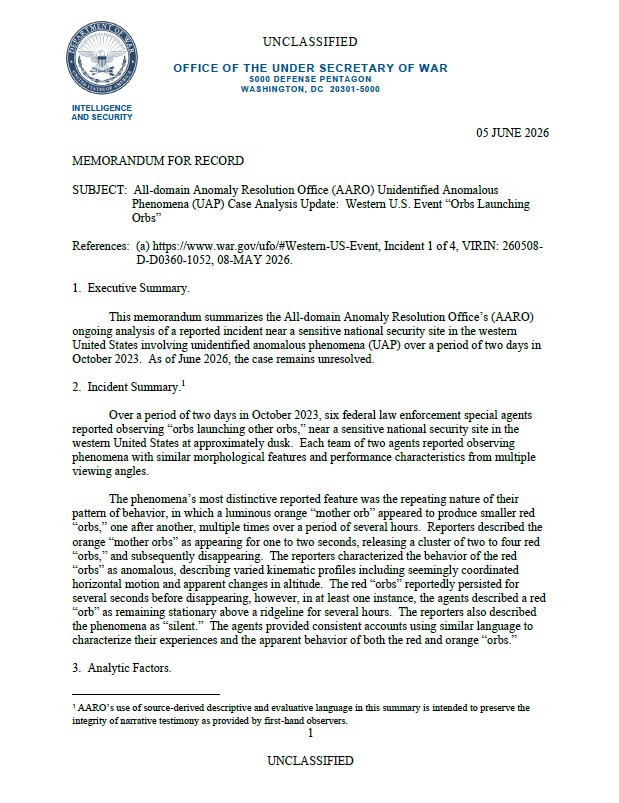 A Department of War memorandum about orbs.
What the framing does capture accurately is a real institutional dynamic. Since the 2017 New York Times story on the Pentagon's Advanced Aerospace Threat Identification Program, the pace of UAP-related official releases has been uneven and sometimes apparently reactive. The AARO reporting requirements embedded in successive National Defense Authorization Acts, the partial declassification of Navy encounter videos, and the multiple rounds of historical file releases under the current administration have created a situation where different agencies are releasing different things on different timelines, with no central coordination visible to the public. Whether that constitutes "losing control" or simply describes a large bureaucracy is a fair question.
Lue Elizondo, the former AATIP director who has become the most publicly visible advocate for military UAP transparency, is mentioned in Gomez's framing as the center of what she calls a "czar fight" — apparently a reference to ongoing disputes about who, if anyone, should coordinate the government's UAP response. The specific nature of that dispute is not documented in the available material.
The documents that may not exist yet
A June 20 post from Gomez references what she describes as a "newly surfaced Pentagon UAP Tiger Team document" — a potentially significant piece of paper, if real. A Tiger Team, in Pentagon usage, is an internal working group assembled to examine a specific problem. A UAP Tiger Team document would represent an internal assessment, not a public-facing release, and its surfacing would be notable. But the document itself is not linked, quoted, or identified by date, classification level, or originating office in the available material. It is a claim about a document, not the document.
"newly surfaced Pentagon UAP Tiger Team document"
The same post describes UFO whistleblowers being "cleared" on what they can reveal — a phrase that could mean formal declassification review, informal guidance, or something else entirely. The post also reports that Vice President JD Vance has admitted he still hasn't read the UFO files.
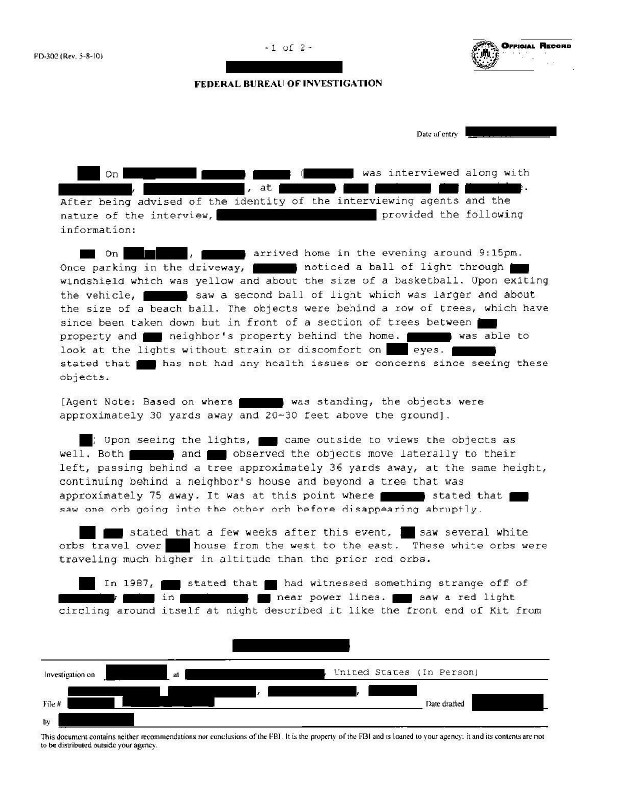 FBI document with redacted text about a light sighting.
Here the available record runs into its first explicit contradiction. Separately, the claim circulates that Trump released the UFO files, and that the Pentagon recently released UFO files. If those releases occurred, a sitting Vice President saying he hasn't read them is a notable admission — but it's also possible the phrase "UFO files" is being used inconsistently across these claims, referring to different tranches or different categories of material. That inconsistency matters. These two positions cannot both be fully true in the same sense simultaneously, and no available source resolves the tension.
A second strand involves the 1996 Varginha incident in Brazil. Gomez's July 10 post describes a congressional CIA records demand tied to the case — lawmakers allegedly pressing the CIA to release files related to what Brazilian witnesses have long described as a crash-retrieval event near the city of Varginha. The congressional demand, if real, would be significant: it would mean U.S. legislators believe American intelligence agencies hold material related to a foreign incident that the Brazilian government has never officially acknowledged. But which lawmakers are making this demand, under what authority, and whether the CIA has responded, is not established in the available material. Whether FBI and CIA files related to Varginha even exist in confirmed form remains an open question.
The NASA thread
Somewhat more tractable is the reference to a new NASA archive review hunting for UAP anomalies in NASA's historical files. NASA established its independent UAP study team in 2022, and that group issued a public report in 2023 that was notable primarily for its candor about data limitations — the team found that existing NASA instrumentation was not designed with UAP detection in mind, and that the available measurements were insufficient to characterize most reported objects. A follow-on archive review, digging through historical mission footage and crew debriefings for anomalies, would be a logical next step and would fit the trajectory of NASA's stated commitments.
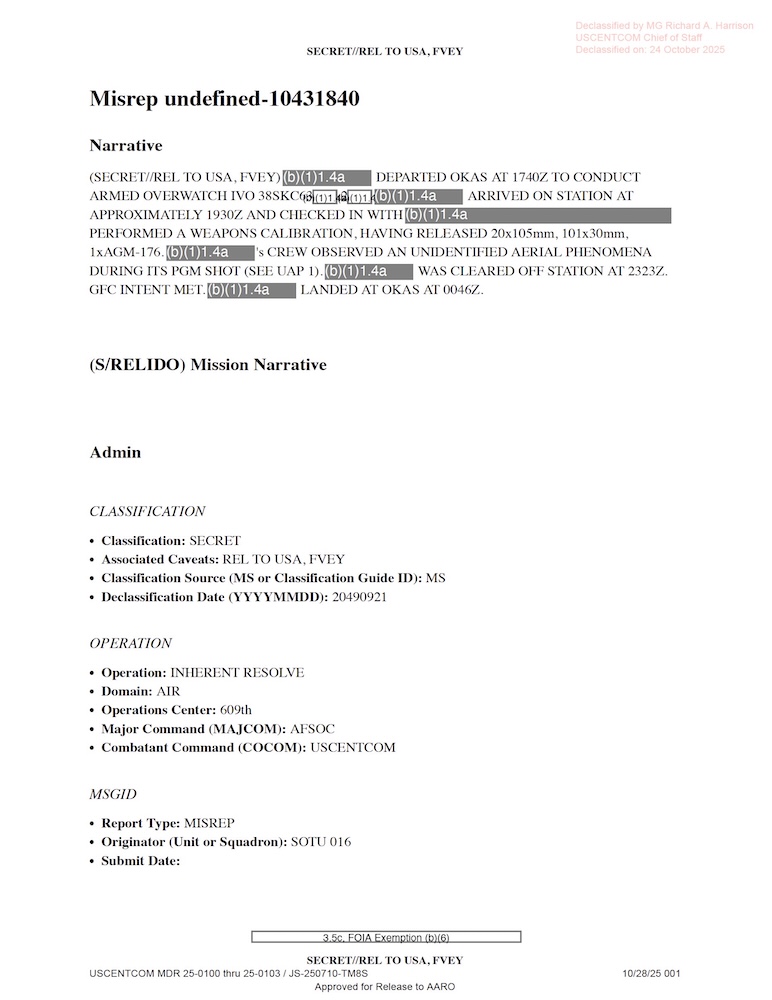 Redacted government mission report document.
Gomez's July post references specific material — the Apollo 17 Technical Crew Debriefing, Mercury Atlas 7 and Mercury-Redstone 4 mission footage, and observations by the Apollo 11 crew — as part of this review. These are real documents. The Apollo 11 Technical Crew Debriefing exists in the historical record and has been discussed by researchers for decades. Whether a formal NASA review is currently cataloguing these materials under UAP identifiers, or whether this framing comes from independent researchers mapping NASA's archive, is not clear from what's available here.
The June 9 Capitol press conference is the one event in this cluster that sits on firmer ground. Grusch's public advocacy, his prior congressional testimony under oath in July 2023, and his alignment with legislators pushing the UAP Disclosure Act are all documented. The Act itself — modeled loosely on the JFK Records Act and designed to create an independent review board for UAP-related government records — has had bipartisan support in committee, though it has not passed in the form its sponsors want. The demand for stronger whistleblower protections, a consistent thread across Grusch's public statements and those of advocates like Elizondo, reflects a real and documented problem: military and intelligence personnel who report UAP encounters have described retaliation, surveillance, and career damage, and current Inspector General protections have significant gaps for classified-program witnesses.
Northland MUFON, a regional chapter of the Mutual UFO Network, was profiled by Valley News Live in early June in connection with the broader wave of federal releases. MUFON is a civilian organization with no official standing, and its case investigations are not subject to the evidentiary standards of government or academic research. Its value here is sociological rather than evidentiary: regional chapters like Northland are where the federal disclosure debate meets local witnesses, and the gap between what Washington is arguing about and what civilians are actually reporting remains largely unmapped.
The specific document or hearing that would change this picture is the Pentagon UAP Tiger Team report Gomez describes. If it exists, if it carries an originating office and a date, and if it reaches a journalist who can verify it against official records, it would be the first internal Pentagon assessment of UAP as a working problem — not a historical curiosity — to enter the public record in confirmed form. Until then, what we have is a credible pattern of institutional pressure and an unverified set of claims about what that pressure has dislodged.