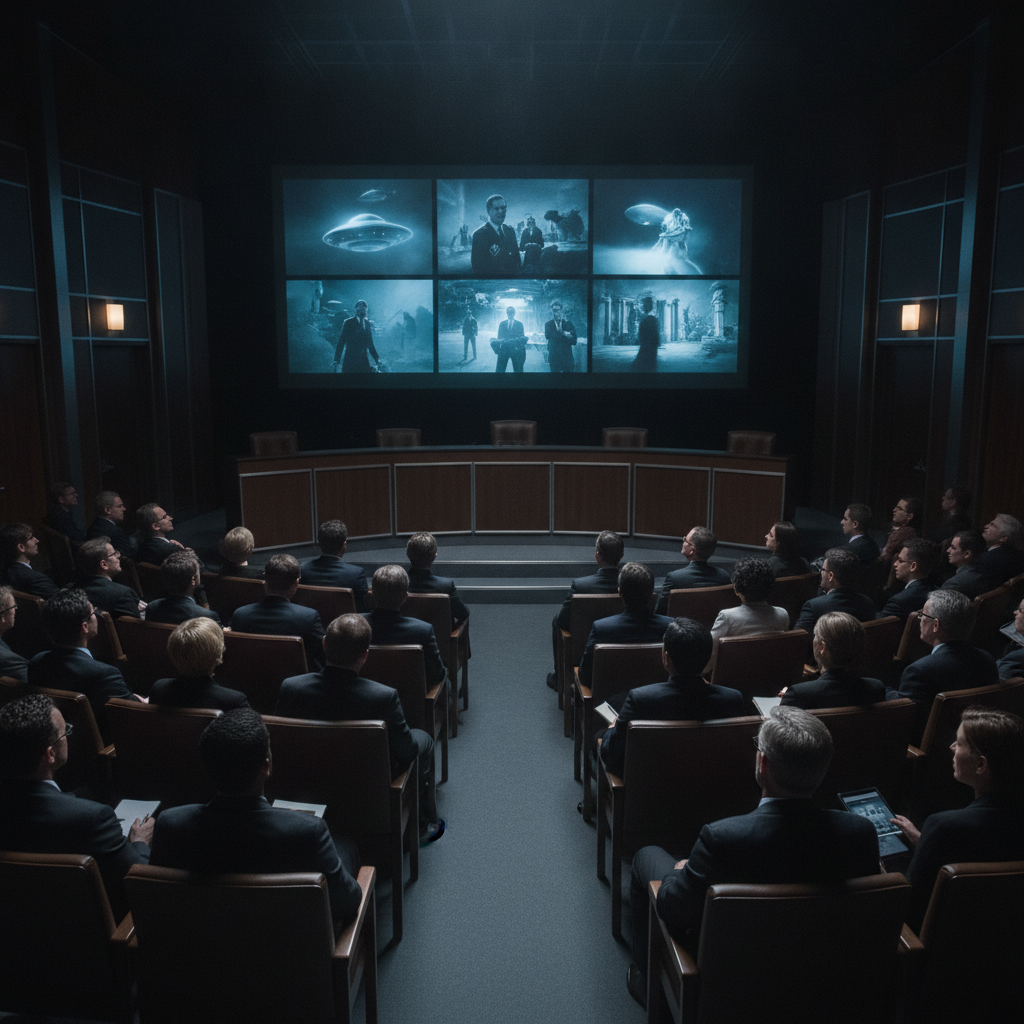
Steven Spielberg's Disclosure Day opened to early screenings in late May 2026 with the kind of reviews directors dream about. IMDb aggregated first reactions describing the film as, in the words circulating among critics, his best work in decades. Entertainment Weekly published its own early-buzz piece the same week. The 930 WFMD Free Talk radio outlet promoted a, by their description, bone-chilling preview. The noise was considerable.
The film, according to Bill Chalker's December 2025 account on his blog The Oz Files, releases June 12, 2026. Chalker, a contributing editor at the International UFO Reporter and the author of Hair of the Alien, described a December 2025 trailer as heavily inflected with religious and consciousness themes — lines like the nun's question, why would God make such a vast universe yet save it only for us, alongside imagery that evokes Spielberg's earlier work across Close Encounters of the Third Kind, E.T., and the 2003 miniseries Taken, which carried the tagline describing three families, four generations, and fifty years of alien encounters. Whether Disclosure Day is a conspiracy thriller, a spiritual reckoning, or something stranger, the film is not yet released as of this writing, and the critical claims — phenomenal, best in twenty years — remain unverified and unattributed to named critics in any source available here.
The film, according to Bill Chalker's December 2025 account on his blog The Oz Files, releases June 12, 2026.
That tension between the hype and the verifiable is worth keeping in mind, because it runs through everything adjacent to this film.
The claim no one has printed
Somewhere in the general excitement about Spielberg returning to UFO territory, a quieter story has been sitting largely unaddressed. It involves a 2001 case in Queensland, Australia — the so-called Amy Rylance affair, also referred to as the Gundiah Queensland alien abduction — that has circulated for years in UFO research communities as a compelling account of a real abduction event.
Bill Chalker investigated it. His conclusion, which he has now stated directly and on the record, is that it was, in his words, a blatant hoax, somewhat made curious by a possible Scientology connection, as dubious as it seemed. That quote comes from an email Chalker reproduced on his blog The Oz Files in July 2025, written to an unnamed UFO podcaster who had been developing a dramatized version of the case.
The Scientology thread is the part that has not been examined in print. Chalker does not fully elaborate on it, noting in Hair of the Alien that his preliminary field investigation, conducted with Diane Harrison, was followed by deeper research whose conclusions he has chosen not to fully publish. The reason he gives is specific: some of the evidence was provided to him in confidence by police and others. So the connection between the Gundiah case and Scientology exists in Chalker's documented record, but the substance of it remains behind a wall of source protection.
What he does say is enough to raise the question. Scientology appears in the same paragraph, in his December 2025 blog post, as Heaven's Gate, the Raelians, and the Aetherius Society — organizations whose intersections with UFO belief he describes as having produced toxic and tragic events. He places the Gundiah case in that company, not as a dangerous religious episode, but as an example of the kind of wayward UFO-religion intersection that distorts serious research.
The more immediate problem Chalker describes is not Scientology but the case's ongoing rehabilitation. Michael Masters, he writes, continues to use the Amy Rylance case to support what Chalker characterizes as Masters' time theory — and continues to do so, Chalker says, despite having been directly advised of Chalker's negative assessment. Masters is not an obscure figure; he has published academic work on the UFO phenomenon. That a researcher of his standing would persist in citing a case that the original field investigator considers a blatant hoax, after being told so, is the kind of institutional dysfunction that the UFO research community rarely surfaces publicly. Chalker surfaced it.
The podcaster who prompted Chalker's email had been developing what Chalker called a dramatic interpretation of the story — effectively a scripted retelling that, in Chalker's view, attributed dialogue of the podcaster's own creation to Chalker himself, without Chalker's knowledge or consent. Chalker's email made clear he would publicly disclaim the episode if it aired. It did not air.
Where Spielberg and Chalker unexpectedly intersect
The connection between a Hollywood blockbuster and a disputed Queensland abduction case from 2001 is not obvious, but it exists in the same intellectual ecosystem that Chalker has been navigating for decades.
In February 2025, Chalker appeared on the Australian ABC radio program God Forbid, hosted by James Carleton, to discuss the relationship between UFOs and religion. The program's framing asked what UFO belief has in common with religion, and what the existence of extraterrestrial life would mean for the existence of God — questions that, based on Chalker's description of the Disclosure Day trailer, Spielberg is asking on a global cinema screen.
The same month Spielberg's trailer dropped, Chalker was being invited onto The Caulfield Podcast, a new show produced out of Western Sydney by Jack Caulfield, a self-described curious generalist whose previous guests had included Professor Geraint Lewis, a cosmologist at the University of Sydney who subscribes to what Chalker calls the Rare Earth school — the position that intelligent life exists nowhere in the universe except Earth. Chalker disagrees with that view. It is a disagreement that sits at the center of every conversation Disclosure Day is likely to provoke.
The coincidence of timing is not evidence of anything. But it does illustrate something real: the Spielberg film is arriving at a moment when the UFO research community's long-running internal arguments — about what constitutes evidence, about who gets to dramatize whose work, about the difference between a good story and a true one — are unusually close to the surface.
Chalker's email to the unnamed podcaster is the clearest expression of that tension available in the public record. His complaint is not primarily about Scientology or even about the Gundiah case. It is about what he calls the dumbing down of serious UFO research, where the story is more important than the facts simply because it might be a good story. The podcaster, he notes, responded in two words and dropped the episode.
The critical reception of Disclosure Day — to the extent that early reactions citing unnamed critics and aggregated by IMDb and Entertainment Weekly can be called a reception — suggests that Spielberg's version of the good story is landing. Whether it is landing because it is true, or because it is well-made, or because the cultural moment is finally ready for a mainstream filmmaker to treat UFO disclosure as a serious dramatic premise, is a question the box office will answer more honestly than any preview cycle.
What the box office will not answer is whether the Gundiah case was a hoax, whether its Scientology thread leads anywhere, or why Michael Masters has continued to build academic arguments on a foundation that the case's original investigator considers rotten. Those questions belong to a different kind of investigation — the kind that requires someone to obtain the confidential police evidence Chalker says he holds, or to formally ask Masters why he has persisted.
Chalker has not published that evidence. Masters has not responded publicly to Chalker's characterization. The podcaster who nearly aired a dramatization of the case has gone quiet. And the film that has accidentally made all of this newly relevant opens in June.
The document to watch for is whatever Chalker eventually publishes — or doesn't — about the Gundiah investigation's full findings. He has signaled it exists. He has signaled he has chosen not to release it. That choice, and what changes it, is the story beneath the story.