Ross Coulthart spent part of a July 2026 episode of his NewsNation podcast Reality Check exploring what he described as new reporting on secret American bases in Antarctica, raising the possibility that those bases could be connected to a visit by former Secretary of State John Kerry. Coulthart also addressed whether NASA knows more about the UAP mystery than it acknowledges publicly, citing claims from former Pentagon official Lue Elizondo that the agency has been less than forthcoming.
Those two threads — Antarctica and NASA — pull in opposite directions. And the more durable story may not be the one getting the clicks.
The Antarctica claim, as presented, rests on thin sourcing. The primary YouTube content discussing a massive Antarctic mothership and 33-foot extraterrestrial bodies in underground caverns comes from a former self-described insider named Emery Smith, interviewed by commentator David Wilcock — neither of whom has produced any verifiable documentation, and both of whom operate entirely outside credentialed journalism or official channels. The UFOs-Disclosure blog, which aggregated this material in May 2026, is a tier-4 source: advocacy-framed, unverified, and without primary document support. Coulthart told his audience he is keeping an open mind on Antarctica — a reasonable journalistic hedge — but the evidentiary gap between his framing and that underlying content is worth naming directly.
The UFOs-Disclosure blog, which aggregated this material in May 2026, is a tier-4 source: advocacy-framed, unverified, and without primary document support.
The NASA question is different. It has a primary document behind it.
What the agency's own scientists actually said
In September 2023, NASA released the final report of its Unidentified Anomalous Phenomena Independent Study Team, a sixteen-member panel that included a retired Navy astronaut, scientists from Boston University, the University of California San Diego, the Planetary Science Institute, and the Federal Aviation Administration, among others. Dr. David Spergel of the Simons Foundation chaired the group. Dr. Daniel Evans of NASA Headquarters served as the designated federal official.
The report's executive summary states plainly that NASA's fleet of Earth-observing satellites typically lacks the spatial resolution to detect relatively small objects such as UAP. This is not a disclosure. It is not a bombshell. It is, in the language of bureaucratic science, an admission that the world's most capable civilian space agency has been flying instruments that are the wrong tools for this particular job.
What makes that sentence interesting is what follows from it. The panel did not conclude that NASA should stay out of UAP research — quite the opposite. It recommended that NASA leverage commercial remote-sensing constellations, which can image at sub-meter to several-meter resolution, to complement federal detection efforts. It called for better sensor calibration, the collection of multiple simultaneous measurements, and the development of metadata standards that currently do not exist. It flagged the Aviation Safety Reporting System — a confidential NASA-administered database that receives approximately 100,000 pilot and air traffic controller reports per year — as an underutilized resource that could, with better targeting, capture UAP reports from commercial aviation professionals.
None of that has happened in any documented, public way. AARO, which the report identified as leading the whole-of-government UAP framework, has yet to release its full fiscal year 2025 consolidated annual report, which was statutorily required under 50 U.S.C. § 3373(k)(1)(A) and is now months overdue. That delay has gone largely unreported.
The public meeting at which the NASA panel presented its preliminary findings took place on May 31, 2023. Dr. Sean Kirkpatrick, then director of AARO, gave a presentation to the panel. Within that same meeting, FAA representative Mike Freie addressed the group. The fact that the FAA, NASA, and AARO were all in the same room in 2023, and that the resulting report recommended systematic data integration across all three, makes the current fragmentation of effort — and AARO's delayed annual report — harder to wave away as bureaucratic routine.
The documents that are actually public
While commentators trade claims about Antarctica and moon anomalies, the Department of Defense has been quietly releasing something more concrete: actual mission reports.
Two documents released through war.gov are worth reading carefully. The first, a declassified mission report designated DOW UAP D3, covers an Arabian Gulf ISR operation in 2020 conducted under AFCENT. Its UAP section documents four objects observed flying in the sensor's field of view, with cloud coverage preventing a clear visual. The precise observation reads: four UAP were observed beneath the aircraft's sensor at approximately 17:36 Zulu — one at 17:36:22, two side by side at 17:36:30, and one at 17:36:49. The vast majority of the document's operational details remain redacted under exemption (b)(1)1.4a, citing classified sources and methods.
 Redacted government mission report document.
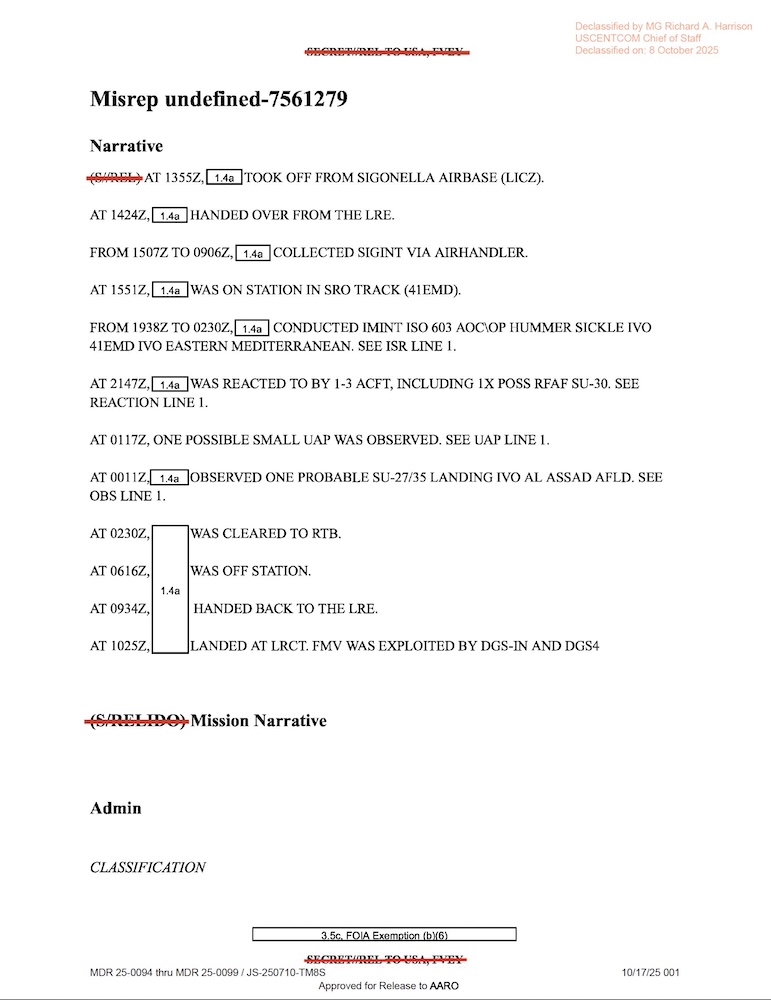
The second, DOW UAP D14, covers a May 2022 ISR mission originating from Sigonella Airbase and operating over the Eastern Mediterranean. The mission lasted over twenty hours. At approximately 01:17 Zulu, one probable small UAP was observed. The document was declassified on October 8, 2025, by Major General Richard A. Harrison, USCENTCOM Chief of Staff, and approved for release to AARO.
These are not proof of anything extraordinary. They are operational records of military aircrews following standard reporting procedures. But they demonstrate something that is sometimes obscured by the volume of unverifiable internet testimony: there is a real, formal reporting architecture in place, and it is producing documents that can be read, dated, and cited.
A third release — a slide deck covering a western U.S. event in May 2026 — is more unusual in character. Six federal law enforcement special agents, designated USPER1 through USPER6, independently reported seeing orange orbs emit smaller red orbs on at least five separate occasions over two days at dusk. The same two agents later observed what they initially took to be a vehicle traveling on a road in a restricted zone; the object then moved laterally off the road over desert terrain at an estimated fifteen to twenty miles per hour without changing orientation, stopped approximately one hundred meters off the road, and turned off its lights. AARO subsequently assessed the object seen in the orb encounter to be between twelve and eighteen meters in diameter and approximately one thousand and fifty meters from the observers — considerably farther than the witnesses initially estimated.
None of this is explained. AARO has not offered a public resolution for any of these cases in the documents released so far.
The credibility stack
Investigating this beat requires holding two things simultaneously: a genuine and documented record of UAP sightings by credentialed military and government observers, and an enormous volume of unverifiable testimony that ranges from the plausible to the plainly unfalsifiable.
The Emery Smith material — described in UFOs-Disclosure posts from May and July 2026 — includes claims about translucent alien skin with turquoise vasculature, webbed eighteen-inch feet stronger than carbon fiber, three-layer cartilage estimated to last three thousand years, and holographic surgical tables that respond to thought. These claims carry no corroborating documentation and originate from a single uncredentialed source amplified by David Wilcock, a commentator with a long record of unverified claims. No U.S. government agency has issued any statement — confirming, denying, or acknowledging — the existence of the facilities or procedures Smith describes.
That silence is worth noting but is not, by itself, confirmation of anything.
The Ross Coulthart material is categorically different in sourcing. Coulthart is an investigative journalist with a documented record of breaking stories that were later confirmed. When he says on his July 2026 Reality Check episode that he has new reporting on secret bases in Antarctica, that claim warrants attention — but also the same question his own audience should be asking: what is the underlying source, and what documentation exists? The NewsNation episode does not answer that question in its published summary, and no official record has been cited to support the Antarctica claim.
Meanwhile, the specific contradiction worth tracking in the current environment involves the UAP files themselves. A bipartisan group of lawmakers joined David Grusch at a June 9 Capitol press conference to demand the release of specific UAP files and passage of the UAP Disclosure Act, according to a Cristina Gomez news summary published by UFOs-Disclosure in June 2026. That same period saw reporting that the Vice President had not read the UAP files — a claim that sits in unresolved tension with the administration's own releases through war.gov. These are not minor procedural inconsistencies. They suggest that the right hand of the disclosure apparatus may not know what the left hand has already published.
The specific document that would change the picture is AARO's overdue fiscal year 2025 consolidated annual report. It would tell us whether the agency has actually integrated the NASA panel's 2023 recommendations, whether the Arabian Gulf and Eastern Mediterranean UAP cases have been resolved, and whether the western U.S. orb encounters have any working explanation. Until it appears, everything else — Antarctica included — is filling a vacuum that the government created.