Avi Loeb was sitting for an interview when he offered his operating philosophy for the most unusual job in American science. "It's like a detective story," he said. "It's a lot of fun, as long as you don't pay too much attention to the critics."
The critics, it turns out, include the man who ran the Pentagon's own UFO office.
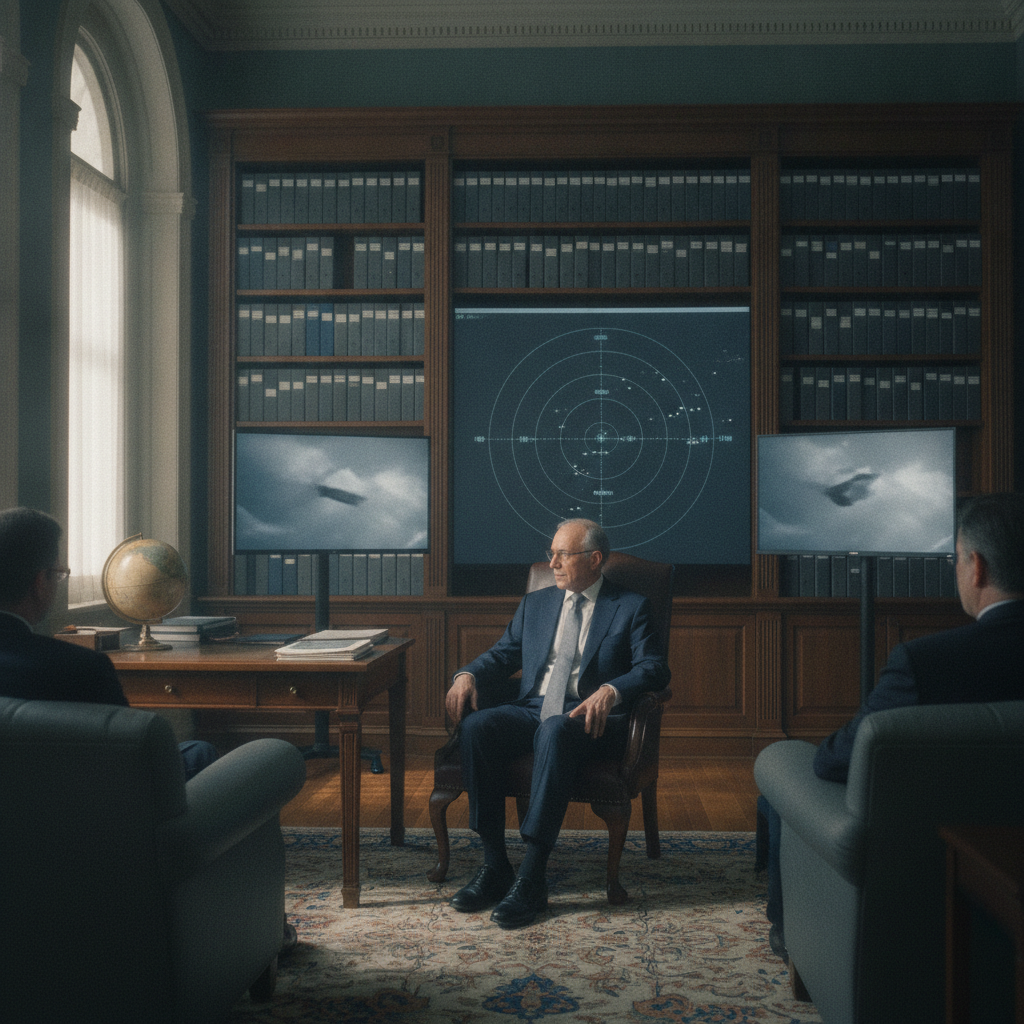
The Associated Press reported on June 30, 2026 that the White House had appointed Loeb, a Harvard cosmologist and former chair of its astronomy department, to lead a new scientific advisory council tasked with investigating UAP — unidentified anomalous phenomena. The council reports to a UAP Governance Board overseen by the Office of the Director of National Intelligence, itself created in response to a directive from President Donald Trump calling for greater transparency on UFOs. According to the AP's reporting, the board held its first meeting in June. The advisory council, after its own initial meeting, sent a request to the Pentagon for more than 50 videos, images, and documents related to known UAP incidents.
Sean Kirkpatrick, the physicist who formerly directed the Pentagon's All-domain Anomaly Resolution Office, told the AP that Loeb is "not viewed favorably" in the scientific community and lacks national security experience — and that the composition of Loeb's team suggests the White House is more interested in fringe theories than hard science. The White House did not respond to the AP's request for comment on that criticism.
The tension here is not merely academic. It goes to a question that has been circling Washington for months: who, exactly, is shaping the disclosure story, and toward what end?
A Council Built for Controversy
Loeb's team is an unusual construction. According to the AP, it includes more than a dozen scientists and UFO activists. Among them is Timothy Gallaudet, a retired rear admiral who has publicly warned about UAP controlled by what he describes as nonhuman intelligence and has claimed the United States has recovered crashed aircraft. Also on the council is Ben Lamm, a billionaire entrepreneur whose primary professional focus is the revival of extinct species. Loeb told the AP he plans to brief the public and create a website to share findings, though the council itself meets behind closed doors.
Loeb's record arriving at this appointment is genuinely contested. His career took a sharp turn in 2017 when, as scientists observed an interstellar object passing through the solar system, he proposed it could be a thin light sail from an alien spacecraft — a claim he made in a paper and later expanded into a book. He subsequently founded the Galileo Project at Harvard, which in 2023 retrieved hundreds of small metallic spherules from the floor of the Pacific Ocean near a possible 2014 meteor crash site. After analysis, Loeb suggested the spherules might have come from a distant planet or from alien technology. Other scholars challenged the finding, saying the material was probably volcanic rock or coal ash. Steve Desch, an astrophysicist at Arizona State University, told the AP that Loeb uses flawed methods to reach exotic conclusions while bypassing the peer review process — a criticism that several other astronomers have made independently.
Loeb is unmoved. "At a time when science is not so much celebrated," he told the AP, "this is an opportunity to actually do good for all sides involved." He says he approaches UAP first from the assumption that they represent human-made technology — a national security framing — while remaining open to larger conclusions if the data leads there.
"At a time when science is not so much celebrated"
What's notable is how Loeb ended up in this position at all. The AP's reporting does not specify who within the administration recommended him or under what statutory authority the council was constituted. Those are not minor gaps. The lack of a named appointing authority and the absence of a public charter mean there is no clear accountability structure for whatever findings the council eventually produces.
The Disclosure Architecture and Its Critics
The formal machinery assembling around UAP disclosure is now considerable. DefenseScoop reported in February 2026 that Defense Secretary Pete Hegseth had reaffirmed Trump's UAP disclosure promise even as the Pentagon's AARO office reported its caseload had surpassed 2,000 individual cases. The Pentagon has released three separate tranches of UAP-related files. NewsNation's Elizabeth Vargas reported that the third release focused notably on plasma orbs. One unnamed UAP whistleblower quoted in that report speculated the orbs could be scouts, though no official assessment supported that characterization.
Despite this cascade of activity, the picture on the inside is messier. Cristina Gomez, reviewing the state of disclosure in a July 2026 video analysis, argued that the government is releasing files it cannot fully account for — and that no single group controls the UFO secret anymore. She also flagged a reported whistleblower amnesty push and what investigative journalist Ross Coulthart has described as a warning of a catastrophic UFO leak — meaning not a controlled release, but an uncontrolled one. Coulthart and NewsNation's Meagan Medick broadcast live from Washington following the UAP Disclosure Forum on Capitol Hill in late June, a gathering that brought together UFO researchers, lawmakers, and, according to a Medium post attributed to Loeb, representatives of the U.S. Senate.
A separate House hearing, opened by Representative Luna and focused on restoring public trust through UAP transparency, had already taken place in September 2025. Congressional attention has not been uniform or coordinated. Linda Moulton Howe and former Deputy Assistant Secretary of Defense Christopher Mellon, in a discussion cited by a tier-4 blog aggregator, argued that classified programs have prevented key information from reaching lawmakers — a claim that sits in direct tension with the administration's simultaneous public release of document batches. Both things can be true, but the contradiction deserves naming: releasing documents is not the same as disclosing programs, and the gap between the two is precisely where the most serious allegations live.
The Vice President's position on all of this is itself unresolved. Gomez's June 2026 review noted a claim that JD Vance had admitted he had not yet read the UFO files — this at a moment when the Pentagon had already released its third document tranche and Hegseth had publicly doubled down on Trump's disclosure pledge. Whether that represents bureaucratic lag, deliberate distance, or something else is not established by the available record.
David Grusch, the former intelligence official whose 2023 congressional testimony first put crash retrieval claims into the formal record, has continued pushing. According to Michael Salla's Exopolitics Today, Grusch has stated he has seen classified photographs of UAP crash retrievals involving craft of different shapes and is calling for those images to be declassified. That claim remains unverified by any primary document or official confirmation.
What the Pattern Suggests
Taken together, these threads describe something specific: a disclosure process that is genuinely accelerating in some dimensions — formal councils, governance boards, document releases, Senate forums — while remaining opaque in the ones that matter most. The scientific advisory council has no public charter. The governance board's mandate is described in general terms. The files being released are real, but their relationship to whatever classified programs Grusch and others allege is entirely unclear.
Dr. Steven Greer, writing and speaking in the weeks around the Capitol Hill forum, argued in a presentation summarized by a tier-4 source that today's disclosure headlines are following what he calls a decades-old script — drawing parallels to the Robertson Panel of 1953 and the Condon Committee of the late 1960s, both government-adjacent efforts that critics have long argued were designed to manage public perception rather than pursue genuine inquiry. Greer's framing is ideologically freighted and his specific claims about suppressed technologies, black sites, and extraterrestrial warnings go well beyond what any available evidence supports. But the structural observation — that official disclosure mechanisms have historically been as useful for containing narratives as for releasing them — is one that even Loeb's critics in the mainstream scientific community would recognize.
Loeb himself seems aware of the tension. He told the AP his impression is that the government is genuinely baffled by some of the objects its personnel have encountered — not concealing answers, but lacking them. "My impression is the government is baffled by not being able to infer the nature of some of these objects," he said.
That may be true. It may also be the most reassuring interpretation available.
The document that would change the picture most sharply is the one the advisory council has already requested: the Pentagon's response to Loeb's formal ask for more than 50 UAP videos, images, and files. What the Pentagon sends back — and what it declines to send — will say more about the real architecture of this process than any forum, hearing, or council charter.