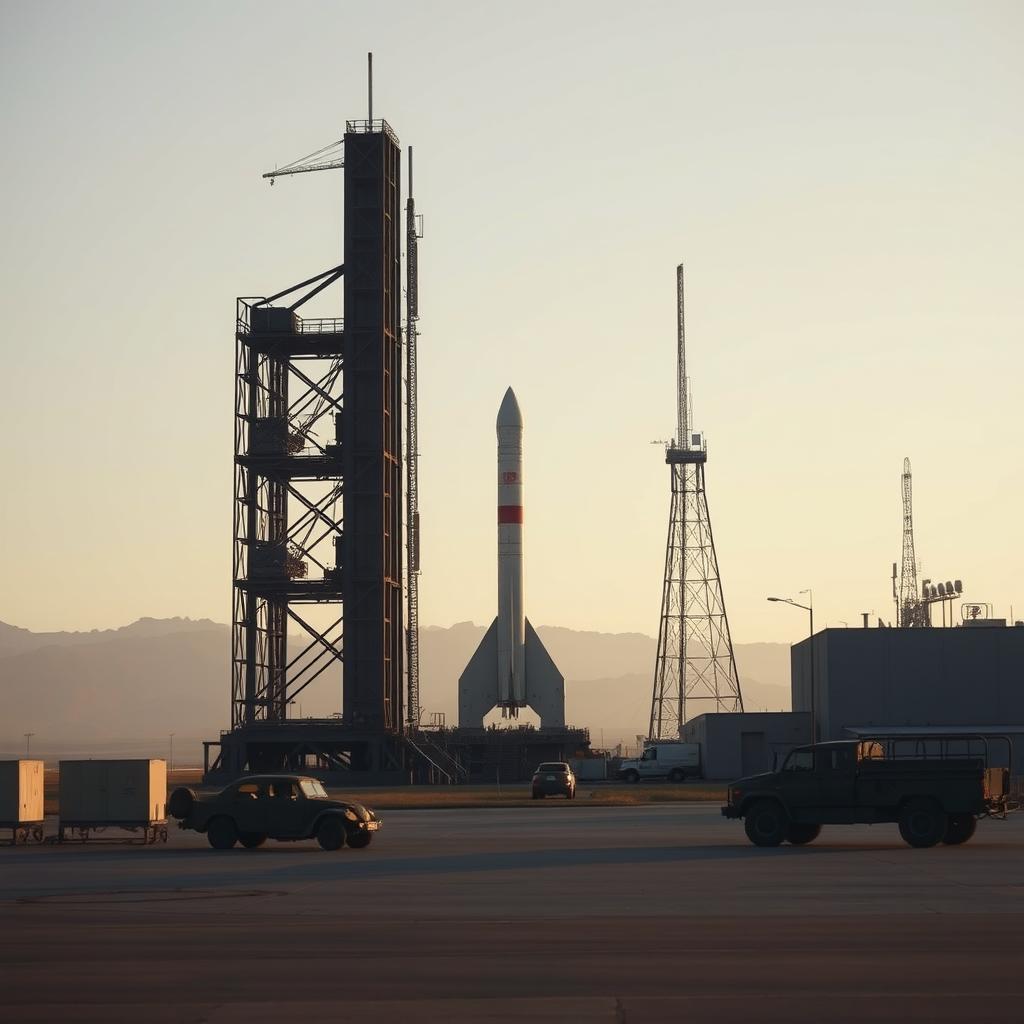
For four decades, Vandenberg Air Force Base served as the United States military's primary West Coast launch corridor — a stretch of California coastline from which ballistic missiles were tested, reconnaissance satellites were lofted into polar orbit, and technologies whose names were still classified were quietly put into space. The official record of that activity, compiled by the 30th Space Wing's Office of History and dated February 3, 2000, now exists as a public document. It is comprehensive, bureaucratic, and — for anyone trying to understand what was actually flying off the California coast during the Cold War — genuinely useful.
The registry, formally titled the Vandenberg AFB Launch Summary 1958–2000, begins with the first launch on December 16, 1958, and catalogs every subsequent major operation in chronological order. According to the document, all launch dates reflect Vandenberg local time, and the cumulative tallies recorded within apply strictly to West Coast operations — explicitly excluding, for instance, Titan IV launches conducted from Cape Canaveral, Florida.
What the Record Contains
The document organizes its data into two primary matrices: an annual launch summary broken down by booster type, and a parallel summary broken down by command authority. A launch facility guide and a glossary round out the reference material. The glossary alone offers an unexpectedly candid window into the range of programs that passed through Vandenberg — entries cover everything from the Advanced Ballistic Reentry System and the Advanced Maneuverable Reentry Vehicle to the Cosmic Background Explorer, the Airborne Surveillance Testbed, and a program identified only as ASTRID, described as an Advanced Single Stage Rapid Insertion vehicle.
The breadth of that list is worth pausing on. Vandenberg was never purely a scientific launch site, nor purely a weapons test range. It was both, simultaneously, for decades — and the glossary of acronyms reflects an institution that ran ballistic missile reentry tests alongside Earth science missions without particular ceremony. Programs like DMSP (Defense Meteorological Satellite Program) and DASO (Distinguished Aircraft and Systems Operations) appear alongside entries like Combat Training Launch and Dual Air Density experiments. The document does not editorialize. It catalogs.
Why the Distribution List Matters
The registry's distribution list is, in its own quiet way, a diagram of how Cold War-era space power was administered. Recipients included not just internal Air Force offices — the 30th Space Wing's history, operations, and public affairs branches — but also major contractors: Boeing Defense and Space Group, TRW, ITT Federal Services Corporation, the Aerospace Corporation, Orbital Sciences, and the Jet Propulsion Laboratory. NASA headquarters received a copy. So did the Kennedy Space Center library.
That the same document landed simultaneously on the desks of Air Force Space Command historians, United States Space Command intelligence analysts, and private aerospace contractors reflects a launch enterprise that was never entirely government-run. Vandenberg's operations were deeply intertwined with the industrial base that built, maintained, and sometimes designed the vehicles being flown. The registry, in that sense, is less a military document than an institutional one — a shared ledger for a shared enterprise.
The foreword, attributed to historian Jeffrey Geiger of the 30th Space Wing History Office, notes that the document is periodically updated and invites questions by DSN line or commercial telephone. It is the kind of administrative language that appears in thousands of government documents. It is also, given the scope of what the registry actually contains, somewhat understated.
Context for UAP Researchers
For researchers focused on unidentified aerial phenomena reported in and around Vandenberg over the same period, the registry offers something specific and limited: a verified baseline of what was officially flying, and when. Witness accounts of unusual objects in the skies above the Central California coast during the latter half of the twentieth century have circulated for years — some involving objects that did not match known launch profiles, some reported by individuals with no knowledge of scheduled operations.
The registry does not resolve those accounts. It was not designed to. What it does provide is a documented framework against which reported sightings can, at minimum, be compared. If an object was observed on a date when the registry records no launch, that absence is at least a data point. If an observation coincides with a classified payload flight whose details remain redacted elsewhere, the registry confirms the launch occurred without necessarily illuminating what was aboard.
That is the nature of official records at this intersection of history: they close some questions and leave others exactly where they were. The launches are documented. What some observers saw — and could not explain — remains a separate file entirely.