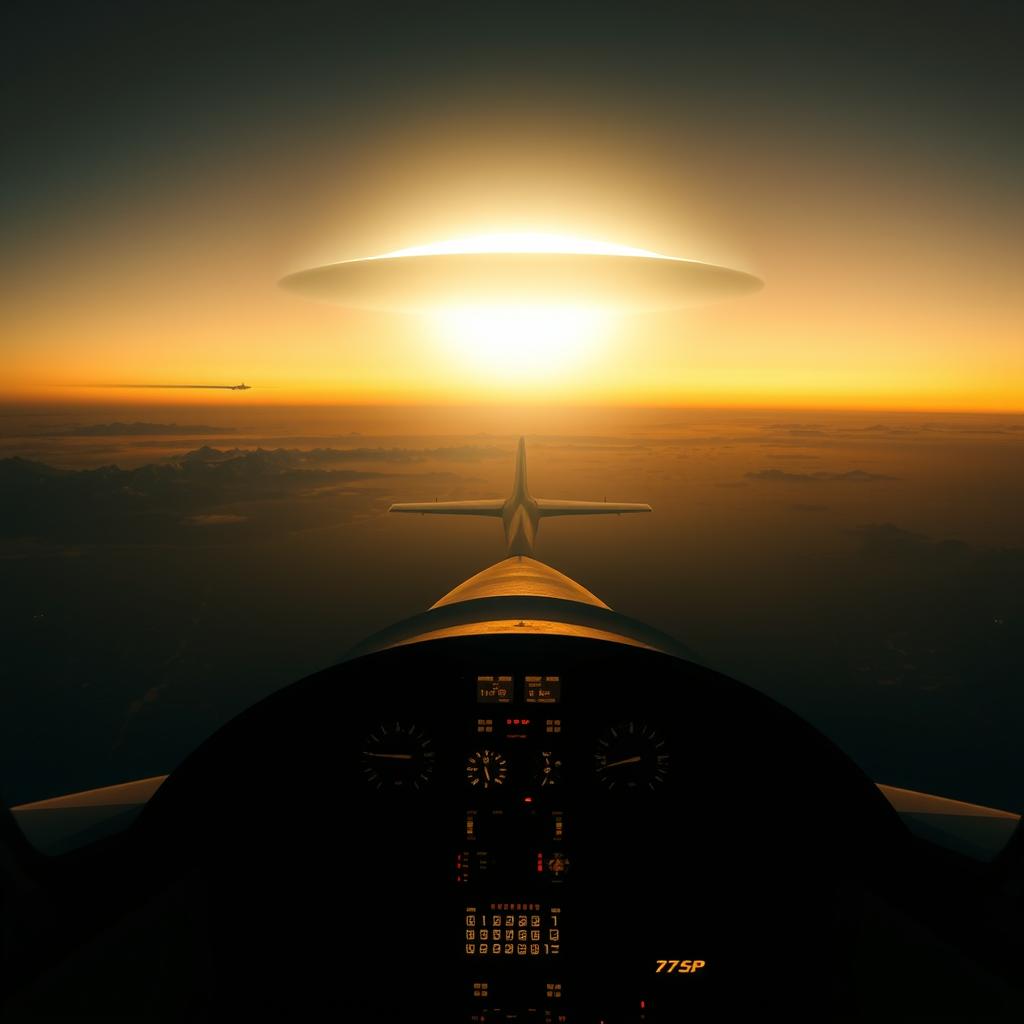
On January 27, 1994, three American pilots flying for Tajik Air reported a prolonged encounter with an unidentified aerial object over Kazakhstan at 41,000 feet — an encounter detailed two days later in a formal cable transmitted from the U.S. Embassy in Dushanbe to the State Department in Washington. The cable, classified under routine handling and recently released in full, offers one of the more methodically documented pilot UFO reports to emerge from the post-Soviet airspace of that era.
What the Pilots Reported
The crew — identified as Tajik Air chief pilot and American citizen Ed Rhodes and two unnamed American colleagues — were operating a Boeing 747SP at latitude 45 North, longitude 55 East when they first observed what the cable describes as "a bright light of enormous intensity" approaching from the eastern horizon at high speed and significantly higher altitude than their own cruising level.
What followed, according to the embassy dispatch, lasted approximately forty minutes. The object performed circles, corkscrews, and sharp 90-degree turns at what the pilots characterized as rapid rates of speed and very high G-forces. These are not maneuvers associated with conventional fixed-wing aircraft operating under known aerodynamic constraints. Rhodes, apparently composed enough to document the encounter in real time, took several photographs with a pocket Olympus camera. The cable notes the photos would be forwarded to the embassy and the State Department's Tajikistan desk — contingent on the images being usable.
After the extended maneuvering phase, the object shifted to a horizontal high-speed course and disappeared beyond the horizon. The crew never identified its shape; the encounter occurred in darkness, and the light was the only visible characteristic.
The Contrail Evidence
The detail that gives this report its unusual texture came roughly forty-five minutes after the initial sighting, as dawn approached. The 747 flew directly beneath the contrails the object had left behind — and those contrails mirrored the reported maneuvers precisely: circles, corkscrews, the same geometry the crew had watched in the dark.
Rhodes estimated the contrails at approximately 100,000 feet. He offered a specific technical observation to explain why that altitude mattered: at that height, there is insufficient air moisture to produce contrails through the propulsion mechanisms of conventional aircraft — including those that could theoretically reach such altitudes. The plane itself was traveling at over 500 knots when it passed beneath them.
That's a significant claim, and it deserves careful handling. Rhodes was described as chief pilot, suggesting professional credibility, but the estimate of 100,000 feet was his own visual assessment from a moving aircraft at night transitioning to dawn — not instrument data. No independent corroboration of the contrail altitude appears in the released material. What the cable does confirm is that physical traces consistent with the reported flight path were observed in daylight by the same crew, which moves this account beyond pure visual testimony into something slightly more substantive.
What the Cable Reveals About Institutional Handling
The cable was filed under the TAGS designations TSPA and EAIR — State Department codes relating to air transport — and distributed not only to Washington but to U.S. embassies in Moscow, Tashkent, Ashgabat, Almaty, Beijing, and Bishkek, as well as to the CIA and DIA. The routing is notable. A routine pilot sighting does not typically generate simultaneous distribution to intelligence agencies and regional diplomatic posts across Central Asia.
The document carries no classification beyond "Unclassified" and was released in full — a designation confirmed by Acting Director John Powers of the State Department's Office of Information Programs on February 25, 2026. Whether any follow-up reporting on the photographs or additional crew debriefings exists in other cables remains unknown from the material available.
What emerges from the cable is a portrait of professional pilots — American citizens operating commercial aviation in a newly independent Central Asian state — filing an unusual report through official diplomatic channels, doing so calmly and with technical specificity. Rhodes didn't editorialize. He described what the light looked like (a "bow wave," resembling a high-speed photograph of a bullet in flight, with a small core and a large trailing emission of heat and light), where it was, what it did, and what it left behind.
Whether the object was experimental aircraft operating at the edge of known capability, an atmospheric phenomenon of an unusual kind, or something that genuinely resists easy categorization, the record now exists — formally, on State Department letterhead, routed to the CIA and DIA, timestamped January 31, 1994. Thirty years later, it's available to read. The photographs Rhodes promised to send have not, to public knowledge, surfaced.