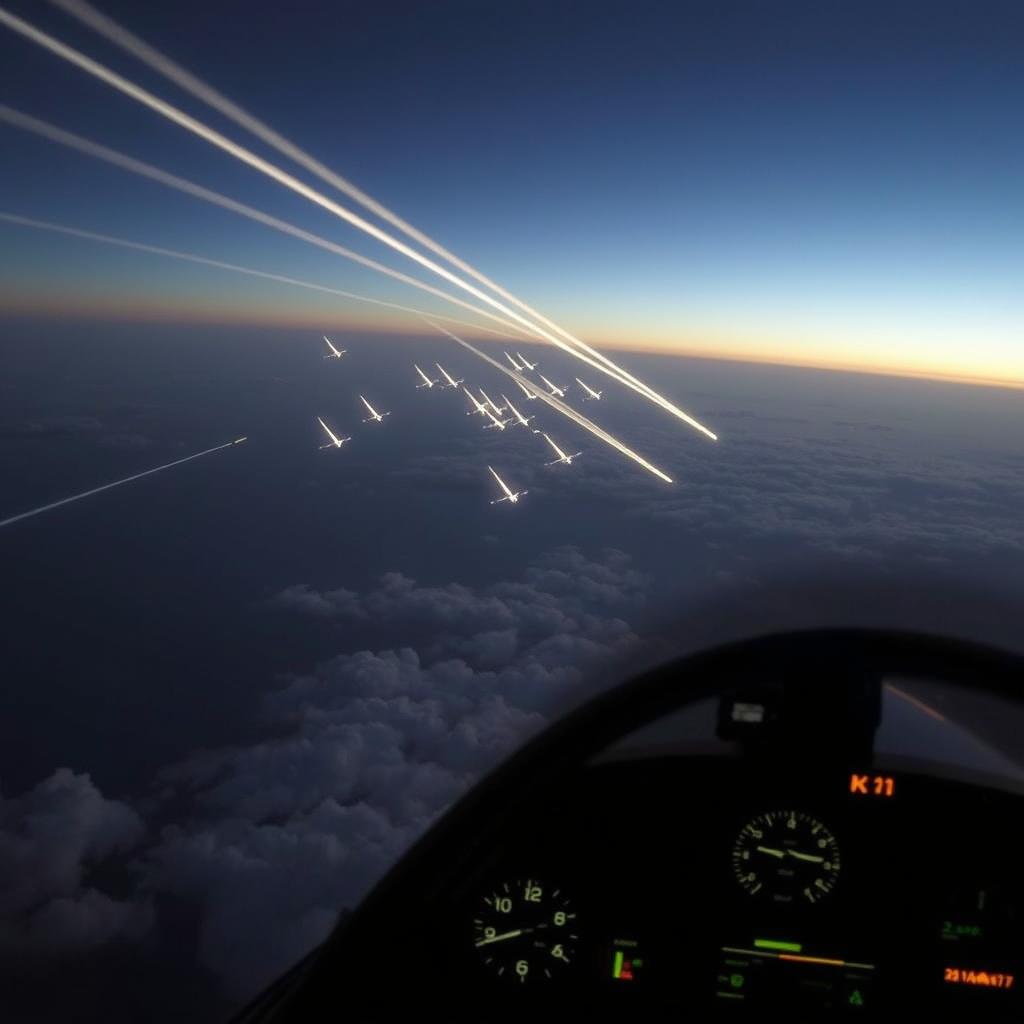
A U.S. military range fouler debrief form submitted through the SPEAR (Standardized UAP/UAS Reporting) reporting channel and dated August 31, 2023, documents an encounter in which a naval aviator assigned to the 482nd Attack Squadron observed multiple unidentified aerial contacts during a flight operation near Japan. The filing, obtained from war.gov and rated at partial reliability given the fragmented nature of the source document, describes objects of consistent size and shape that appeared to maneuver among one another at altitude, with at least three contacts visible on sensor displays simultaneously at one point during the engagement.
What the Pilot Reported
According to the debrief form, the O-2-ranked pilot — whose identifying information was sanitized per SPEAR protocol — first observed a single object transiting the sensor display and initiated tracking. The initial contact was then overtaken by a second object described as the same size and shape but moving at "much higher speed." The pilot's narrative states that at one point during tracking, three objects were visible on screen "moving amongst each other."
The form records the contact altitude at 118,000 feet — a figure that, if accurate, would place the objects well into the stratosphere and above the operational ceiling of virtually all known conventional aircraft. That figure warrants scrutiny: the debrief form provides a parenthetical example reading "22,000" for the altitude field, suggesting the 118,000-foot entry is the pilot's own reported data rather than a placeholder. UFOPress was unable to independently verify this altitude reading from the available source material.
The contact was recorded as moving, with a listed direction and speed of 150 degrees at 230 knots. Altitude was noted as constant. Wind data at contact altitude was also logged. The pilot checked "Other Shape" rather than any of the standard descriptors (round, square, balloon-shaped, or winged), and indicated apparent propulsion while noting no visible moving parts. No metallic, translucent, opaque, or reflective characteristics were checked, and no markings were indicated — though the fragmented condition of the source document makes it possible that some checkbox fields were not fully rendered in the available copy.
Reporting Infrastructure and Document Provenance
The form itself is a SPEAR Range Fouler Debrief Form, a standardized military instrument designed to collect aircrew observations of unidentified contacts that intrude upon restricted operating areas — so-called "range foulers." According to the document's own instructions, SPEAR sanitizes all reports of identifying information before analysis, and aircrew are directed not to use a standard submission button but instead to save and email the completed PDF to a redacted address, suggesting a centralized collection workflow.
The document header includes partially legible classification and handling markings consistent with controlled unclassified or low-level classified material, though the rendering of those markings in the available source is too degraded to state with confidence what the original classification level was. The MGRS grid coordinate field for the initial contact is also partially redacted in the available copy, with only a partial grid string visible.
The source domain, war.gov, carries a trust rating of 60 percent in UFOPress's editorial assessment, reflecting uncertainty about document completeness and the degraded OCR quality of the filing. The core narrative — multiple objects of consistent appearance, one overtaking another at higher speed, three simultaneously tracked — is internally coherent and consistent with the format and language of previously disclosed SPEAR-type filings. However, no corroborating sensor data, video, or secondary witness accounts are available in this source package.
Context and Significance
The filing adds to a growing body of standardized military UAP reports originating from the Indo-Pacific theater, a region that has featured in prior congressional testimony and Office of the Director of National Intelligence annual UAP reports as an area of persistent unidentified contact activity. The simultaneous tracking of three objects — if the sensor data holds up under further review — would represent a more complex event than the single-object encounters that dominate publicly available SPEAR-type disclosures.
The stratospheric altitude claim, if verified, would also be analytically significant. Most documented military UAP encounters occur at altitudes consistent with conventional aviation. An object maneuvering at or above 100,000 feet while maintaining a stable trackfile and consistent shape would narrow the field of prosaic explanations considerably, though high-altitude balloon clusters, sensor artifacts, and data entry errors remain on the table absent additional corroboration.
UFOPress has submitted a request for comment to the Department of Defense's All-domain Anomaly Resolution Office regarding this filing. No response had been received at time of publication.