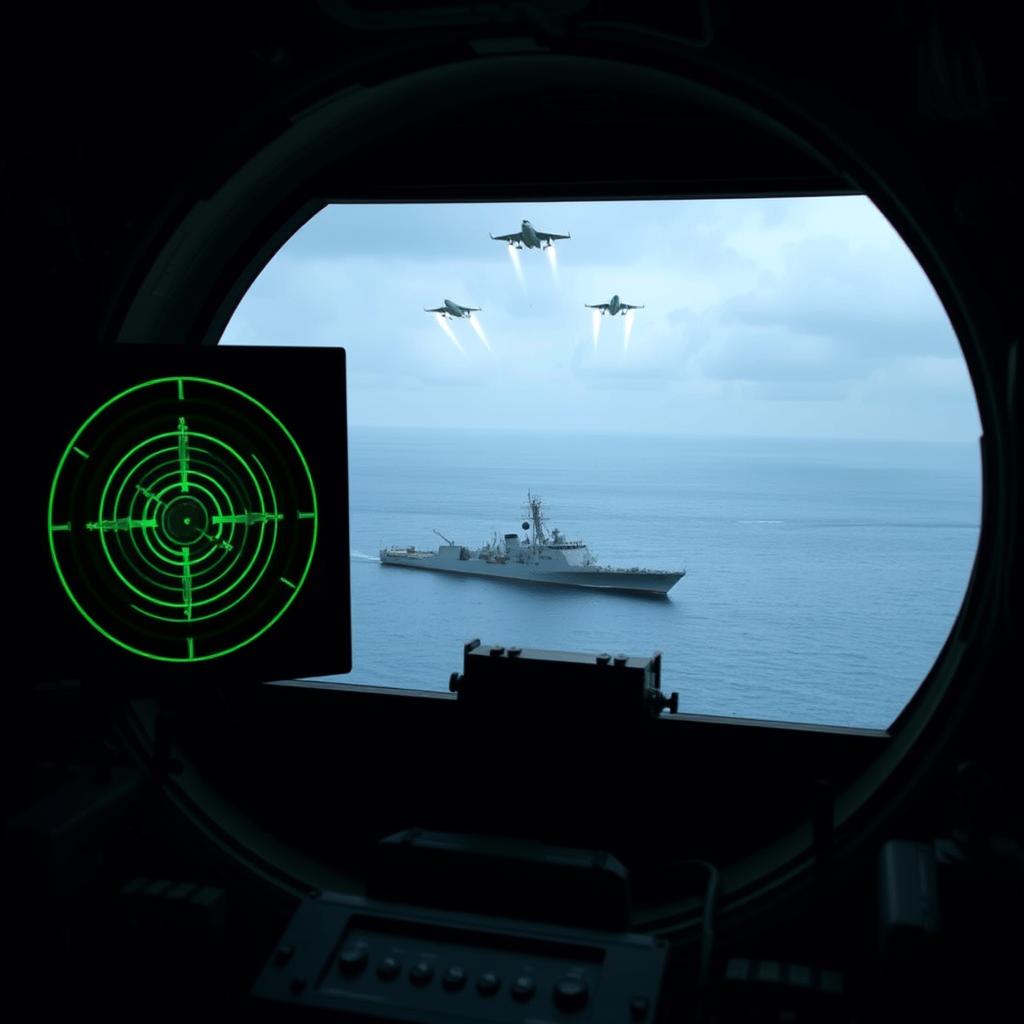
A partially declassified military mission report designated DOW-UAP-D5 documents two separate unidentified aerial phenomena encounters in the Arabian Gulf region during 2020, with observers recording objects exhibiting steady flight characteristics in one instance and apparent acceleration with directional change in another. The report, attributed to the Department of War and carrying a SECRET//REL classification marking on its unredacted portions, represents one of a small number of official military UAP incident records to enter the public domain in recent years.
First Encounter: Steady Velocity at Flight Level 160–170
According to the document, the first sighting occurred at 1354Z at grid coordinates in the vicinity of 34SCE7566990098. A single UAP was observed traveling at 40 knots between flight level 160 and flight level 170 — roughly 16,000 to 17,000 feet altitude. The report notes that the object's speed "remained constant," a detail that may be relevant to subsequent analysis, as consistent, unvarying velocity can complicate identification against both conventional aircraft and atmospheric phenomena.
The identity of the observing platform or unit is redacted throughout under exemption 1.4(a), which covers information that could reveal sources and methods, intelligence activities, or foreign relations equities. Additional contextual details — including sensor type, duration of observation, and any attempted intercept or communication — are similarly withheld. The redactions significantly limit independent assessment of the event.
Second Encounter: Estimated 278 Knots, Course Change to the South
A second entry in the same report describes an observation at 2243Z — approximately nine hours after the first — at a different grid location, in the vicinity of 35TQK1580995057. On this occasion, observers reported two possible UAPs traveling at an estimated velocity of 278 knots. The report states the objects "increased speed and changed direction towards the south."
The use of "POSS UAPS" — possible unidentified aerial phenomena — in the second entry suggests the reporting unit exercised some degree of analytical caution, declining to make a definitive classification. The combination of speed, acceleration, and directional shift described in the second encounter is consistent with the class of UAP behaviors that have drawn congressional attention in recent years, though the single-source, heavily redacted nature of this document makes independent corroboration impossible at this time.
It bears noting that 278 knots, while notable in context, falls within the performance envelope of various conventional military and commercial aircraft. The significance of the reported speed increase and direction change depends heavily on the sensor modality used to track the objects — information that remains redacted.
Source Reliability and Document Limitations
The document originates from a source assessed at moderate-to-low reliability for the purposes of this publication. The "Department of War" designation is itself an anomaly — the department was formally redesignated the Department of Defense in 1947 — and the provenance of the document cannot be independently confirmed through publicly available official channels. UFOPress was unable to verify the document against any corresponding entry in official Pentagon or congressional UAP disclosure records as of publication.
Extensive redactions under exemption 1.4(a) remove the names and organizational identities of all observing units, preventing independent corroboration with named military personnel. The document does not indicate whether either sighting was reported to the All-domain Anomaly Resolution Office (AARO) or its predecessor organizations, or whether radar, infrared, or other sensor data was preserved for further analysis.
The grid coordinates included in the unredacted portions place the encounters in the broader Arabian Gulf theater, a region with historically dense military air traffic and longstanding UAP reporting activity. The U.S. Navy and other services have documented multiple UAP encounters in maritime operational environments, several of which have been formally acknowledged by the Pentagon and reviewed in classified congressional briefings.
UFOPress has submitted a Freedom of Information Act request seeking any related records from the Department of Defense and will update this report if additional documentation becomes available. Readers with direct knowledge of either encounter who are willing to speak on record are encouraged to make contact through secure channels listed on our submissions page.