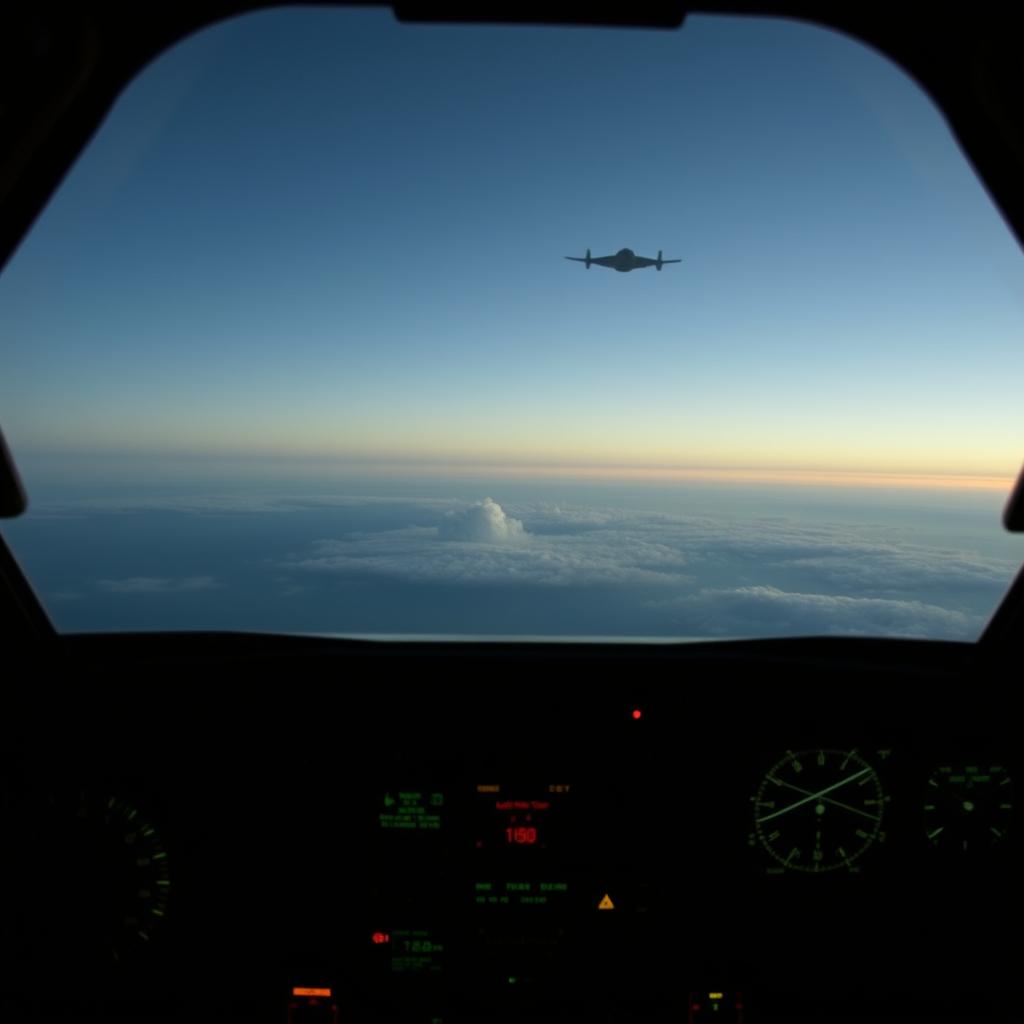
U.S. military aircraft operating in the Indo-Pacific Command area of operations reported two brief possible unidentified aerial phenomena encounters within roughly 14 minutes of each other across consecutive days in early April 2025, according to unclassified tearline reports confirmed by the Office of the Undersecretary of Defense for Intelligence and Security (OUSDI&S).
What the Records Show
The disclosures appear in an internal email chain, released under what appears to be a records request process, involving personnel at 12th Air Force Detachment 3 and an Information Disclosure Analyst at the OUSDI&S. The correspondence centers on a request to confirm that two short incident summaries — referred to as "tearlines" — could be released at the unclassified level, and that the Indo-Pacific Command (INDOPACOM) area of responsibility designation could similarly be disclosed without classification concern.
According to the document, a PAROC Intel Data Analysis Technician and Team Lead at 12 AF/Det 3 initiated the exchange, writing that unit personnel had verbally confirmed the tearline content was unclassified. An Information Disclosure Analyst at the OUSDI&S subsequently provided written confirmation, stating: "I wanted to clarify that these tearlines are approved at the UNCLASSIFIED level."
The two approved tearlines read as follows:
"US AIRCRAFT OBSERVED 1X POSS UAP FOR 12 SECONDS AT 2353Z, FLYING AT UNK ALTITUDE AND UNK SPEED, NO INTERFERENCE WAS NOTED." — 10 APR 25
"US AIRCRAFT OBSERVED 1X POSS UAP FOR 23 SECONDS AT 0007Z, FLYING AT UNK ALTITUDE AND UNK SPEED, NO INTERFERENCE WAS NOTED." — 11 APR 25
The two observations, at 2353Z on April 10 and 0007Z on April 11, occurred approximately 14 minutes apart — effectively consecutive events straddling midnight UTC. Both reports note unknown altitude and unknown speed for the observed object, and both confirm no interference with the observing U.S. aircraft was recorded.
Classification and Chain of Confirmation
The email chain itself is marked SECRET//NOFORN at the header level, which is a routine protective marking for internal military correspondence that may reference or adjoin sensitive material — even when the specific content being discussed has been cleared for public release. The tearline summaries themselves carry explicit UNCLASSIFIED markings in the final confirmed versions.
The involvement of the OUSDI&S in confirming the classification status of the tearlines is consistent with standard DoD information review procedures, wherein operational incident summaries are scrubbed for releasable content before any public or lower-classification disclosure. The source document does not identify the specific aircraft type, the precise geographic coordinates of the encounters, or the platform's mission at the time of observation. Those details remain redacted under exemption 1.4(a), which covers information pertaining to military plans, weapons systems, or operations, as well as under (b)(6), the personal privacy exemption.
It is not possible from the available record to determine whether the two sightings involved the same object or two distinct phenomena, nor whether any follow-up investigation was initiated. The language "POSS UAP" — possible UAP — is standard hedging language in initial military incident reports and does not constitute a formal classification of the object as anomalous.
Context and Limitations
The document originates from a source domain assessed at moderate-to-low confidence (war.gov, trust score: 40%), and UFOPress has not independently verified the document's provenance or confirmed it through a separate Defense Department channel. The formatting and classification conventions present in the record are consistent with authentic DoD internal correspondence, and the institutional actors named — 12 AF/Det 3 and the OUSDI&S — are real and appropriately positioned to conduct this type of classification review.
INDOPACOM has been a recurring area of interest in UAP reporting, particularly given the concentration of U.S. military flight operations and the proximity to contested airspace. Congress has in recent years pressed the DoD to improve UAP reporting fidelity in operational theaters, including the Pacific. Whether these April 2025 reports were submitted into the All-domain Anomaly Resolution Office (AARO) tracking system is not addressed in the available documentation.
UFOPress has submitted a request for comment to the Office of the Secretary of Defense and to AARO. No response had been received at time of publication. The 12-second and 23-second observation windows described in the tearlines are consistent with brief visual or sensor contacts of the kind documented in other unclassified UAP incident summaries released in recent years, though the absence of altitude, speed, and platform data limits any meaningful technical analysis of the reports.