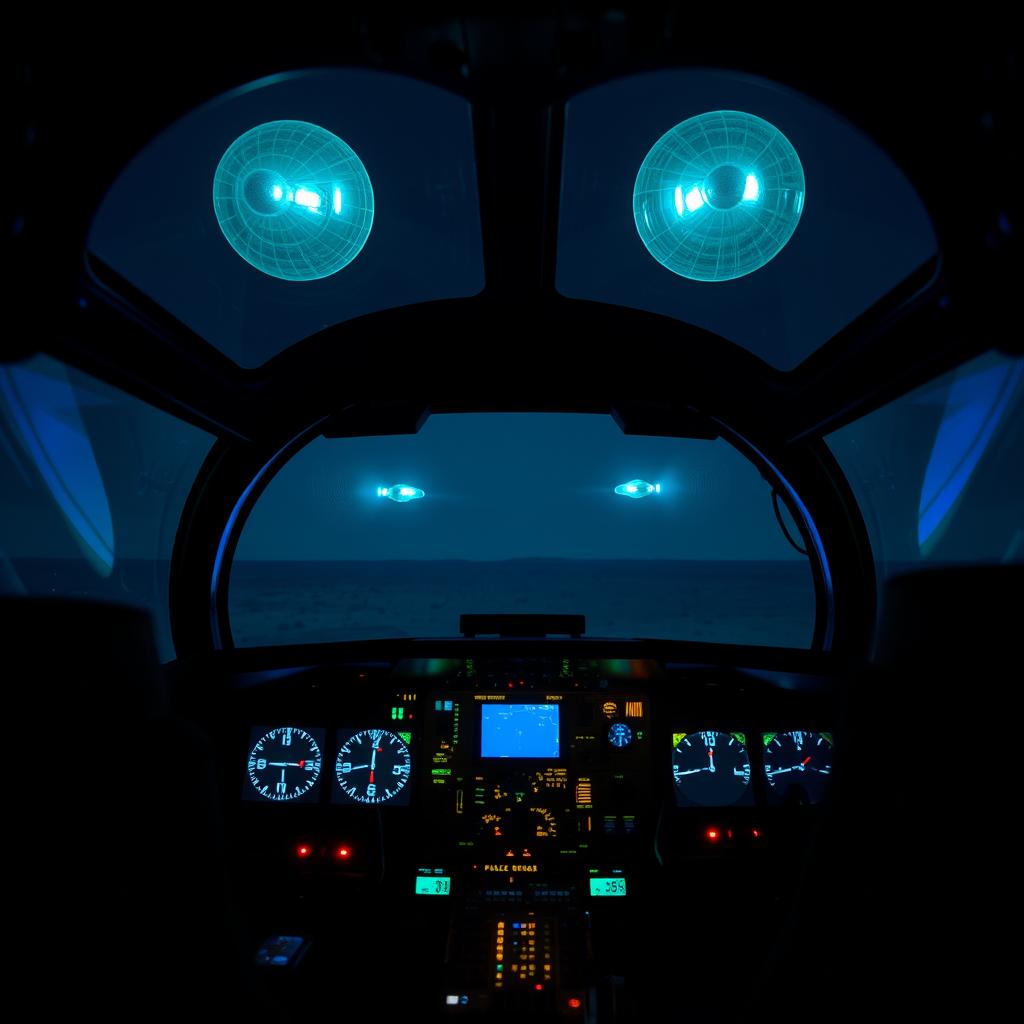
A declassified military debrief form, designated DOW-UAP-D58 and released under the authority of Major General Richard A. Harrison, documents a October 2020 encounter in which a U.S. Navy pilot obtained a radar lock on two unidentified contacts above a domestic training range — objects that displayed apparent electronic jamming capability and movement the reporting aviator described in terms that warrant careful attention.
The form, stamped with a range fouler debrief classification and processed through the SPEAR reporting system — a military channel designed to collect data on unidentified contacts sanitized of aircrew identifying information — was filed at 01:12 Zulu on October 27, 2020. The pilot was flying a defensive counter-air mission, designated DCA, at night.
What the Pilot Reported
According to the declassified document, the contacts were first detected at a bullseye reference of 248/17 and subsequently tracked via radar. The pilot established a stable trackfile, achieved target pod video in the infrared spectrum, and confirmed two contacts within the same group. The objects were characterized on the form as metallic, balloon-shaped, opaque, and reflective — with no visible wings, airframe, or apparent propulsion.
The contacts were moving on an approximate heading of 060 degrees at roughly 20 knots, with some variation toward 090 degrees at 15 knots. They were detected at approximately 22,000 feet altitude, with the pilot positioned at 26,000 feet.
The narrative section of the form is where the account becomes difficult to file under routine airspace anomaly. In the pilot's own words, as recorded in the document:
"KINGPIN DIRECTED ID OF UNKNOWN CONTACT. OBTAINED RADAR LOCK AND TARGET POD VIDEO BUT UNABLE TO GET CLOSER THAN 16.9NM TO GET A BETTER ID. THE TARGET POD SHOWED 2 IR SIGNIFICANT CONTACTS. ONE RANGE FOULER WAS CIRCLING AROUND THE OTHER IN 1/30TH OF A SECOND, THEY WERE GONE. TALLY ACHIEVED WAS 2X RED BLINKING STROBES AND NOISE JAMMING WAS RECEIVED. NOISE JAMMING WAS INDICATED BY TWO CHEVRONS."
The pilot was directed by a controlling authority, callsign KINGPIN, to identify the unknown contact. Despite achieving radar lock and infrared sensor tracking, the aircraft could not close to within 16.9 nautical miles — a distance that, depending on atmospheric conditions and sensor configuration, would leave visual confirmation marginal at best.
The Jamming Claim and What It Implies
The noise jamming indication is the detail that separates this report from the category of wayward balloon or misidentified civilian aircraft. Noise jamming — a form of electronic warfare in which a system floods a radar receiver with interference — is not something a weather balloon produces. The two-chevron indicator referenced by the pilot is a standard cockpit warning associated with active electronic attack against the aircraft's radar systems.
If the indication was accurate and not a sensor anomaly, it would suggest the objects were either equipped with, or in proximity to, active electronic countermeasures. That possibility carries significant implications regardless of what the objects ultimately were: foreign adversary technology operating inside a U.S. military training corridor, a classified domestic program the pilot wasn't read into, or something that doesn't fit neatly into either category.
The form itself makes no determination. SPEAR reports are data collection instruments, not analytical conclusions. The checkbox fields — metallic, reflective, opaque, balloon-shaped — reflect a pilot's best visual and sensor assessment under operational conditions, not a confirmed identification. The "ambiguous arc" box under electronic attack indicators was checked alongside the jamming notation, which introduces some interpretive caution. Ambiguous returns can result from terrain, atmospheric ducting, or equipment artifacts.
Context and Unresolved Questions
The October 2020 timeframe places this encounter within a period of accelerating institutional attention to UAP reports. The Office of Naval Intelligence had by then formalized UAP reporting channels, and the predecessor to what would become the All-domain Anomaly Resolution Office was being assembled within the Pentagon. Pilots were being encouraged — in some cases for the first time in their careers — to report anomalous contacts without fear of professional consequences.
What the declassified form cannot tell us is whether this contact was ever cross-referenced against ground radar, space surveillance assets, or signals intelligence collection from the region. The SPEAR system was designed to aggregate pilot reports; whether any analytical follow-up occurred on DOW-UAP-D58 specifically is not reflected in what has been released.
The movement described — one object circling another in approximately one-thirtieth of a second before both disappeared — sits in a category of reported UAP behavior that has appeared in other military accounts: sudden acceleration, rapid positional change, and departure without discernible propulsion signature. Whether that reflects genuine physics, sensor limitation, or perceptual compression under stress is a question the document cannot answer.
What it does confirm is that a trained military aviator, flying a directed intercept tasking under operational conditions, filed an official report describing objects he could not identify, could not close on, and could not explain — and that the institution he served preserved that account in a classified record that has now been released to the public.