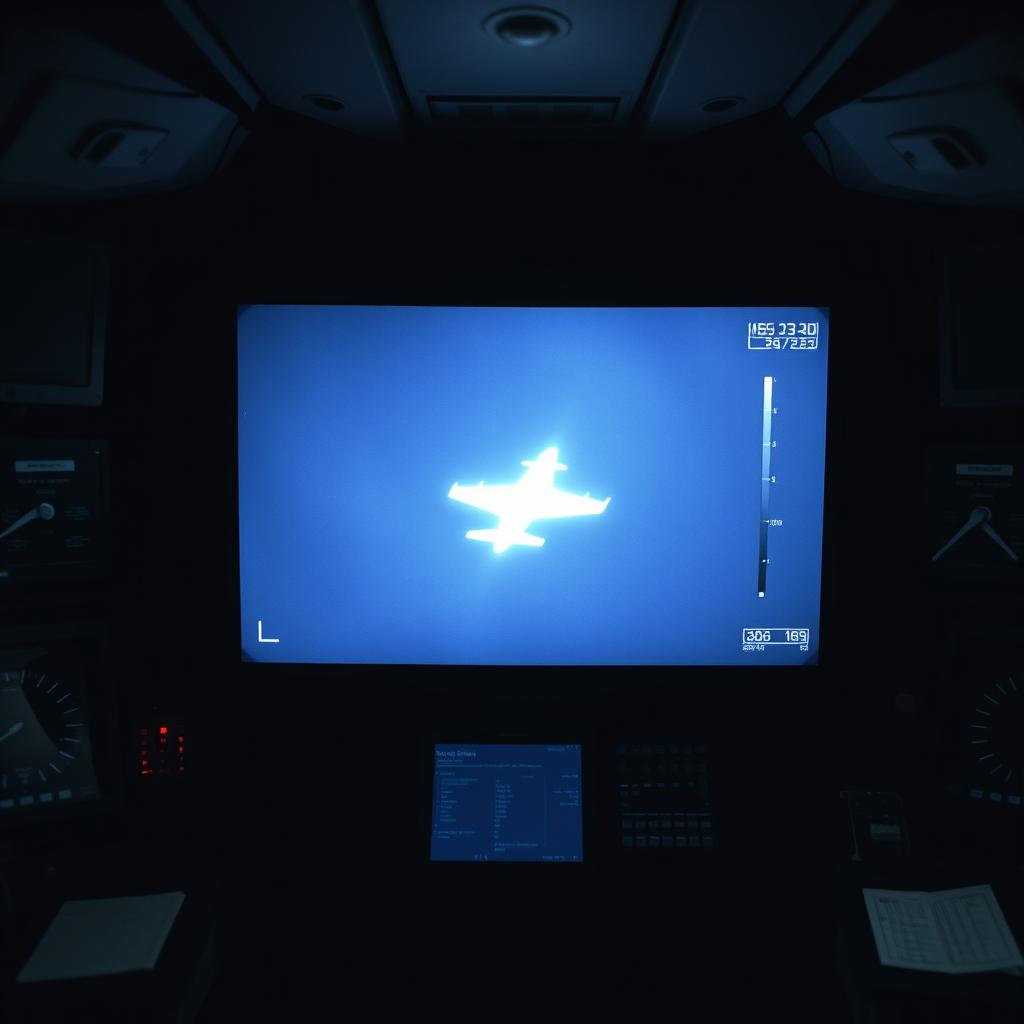
The Department of the Army submitted an unresolved unidentified anomalous phenomenon report to the All-domain Anomaly Resolution Office in 2026, consisting of one minute and 49 seconds of infrared sensor footage captured from an unspecified U.S. military platform. The reporting service member provided no oral or written description of the observation, leaving AARO without contextual information typically used to begin an investigation.
What the Footage Shows
According to the report published by the Department of War under case designation DOW-UAP-PR49, the infrared video captures what are described as "areas of contrast" — a neutral, non-interpretive term used in the official video description to avoid prejudging the nature of the objects depicted. The footage does not appear to show a single object; the sensor is observed tracking two such areas of contrast simultaneously.
The video description, released for informational purposes, details a sequence in which the sensor first tracks an initial area of interest before panning right to left to acquire and center two areas of contrast within the frame. The sensor then widens its field of view before a brief period in which zoom levels cycle rapidly — causing the objects to appear to grow and shrink in size — before the sensor resumes steady tracking through the remainder of the footage.
The report is explicit that the video description "should not be interpreted as reflecting an analytical judgment, investigative conclusion, or factual determination regarding the described event's validity, nature, or significance." No altitude, speed, location, or platform type is disclosed in the publicly available filing.
A Submission Without Context
The absence of any accompanying verbal or written statement from the observing personnel is notable. AARO's standard investigative process relies on a combination of sensor data and firsthand observer accounts to characterize UAP reports. Without a description of what the operator observed in real time — including perceived behavior, distance, or environmental conditions — analysts are limited to what the infrared sensor itself recorded.
Infrared footage presents its own interpretive challenges. Contrast differentials visible in thermal imaging can be produced by a wide range of phenomena, including atmospheric thermal gradients, birds, insects at close range, or conventional aircraft at distance. Sensor artifacts, including blooming and focus anomalies, can further complicate assessment. The rapid zoom cycling noted between timestamps 01:04 and 01:08, while consistent with an operator attempting to characterize an object, could also introduce visual distortion that complicates size and shape estimation.
AARO has not issued a public resolution or analytical finding for this case. The report's designation as "unresolved" reflects the office's current inability to assign the observation to a known category — not a determination that the footage depicts anything anomalous in the colloquial sense.
Institutional Context
AARO was established under the National Defense Authorization Act to serve as the central repository and investigative body for UAP reports across the military services and intelligence community. The office is required to accept reports from all domains and branches, including Army ground and aviation assets, which historically have contributed fewer UAP reports than naval and air force platforms operating in contested or open airspace.
The Army's submission of this case, incomplete as it is, reflects the broader institutional effort to normalize UAP reporting across the force. Prior to AARO's establishment and the cultural shifts prompted by congressional attention to the issue beginning in 2021, service members in many branches reported significant stigma associated with filing UAP observations. The current report, whatever its ultimate resolution, represents the kind of raw intake AARO was designed to receive.
What AARO does with single-source, context-free infrared submissions — and how such cases factor into the office's aggregate reporting to Congress — remains an open question. The office has not commented publicly on DOW-UAP-PR49.