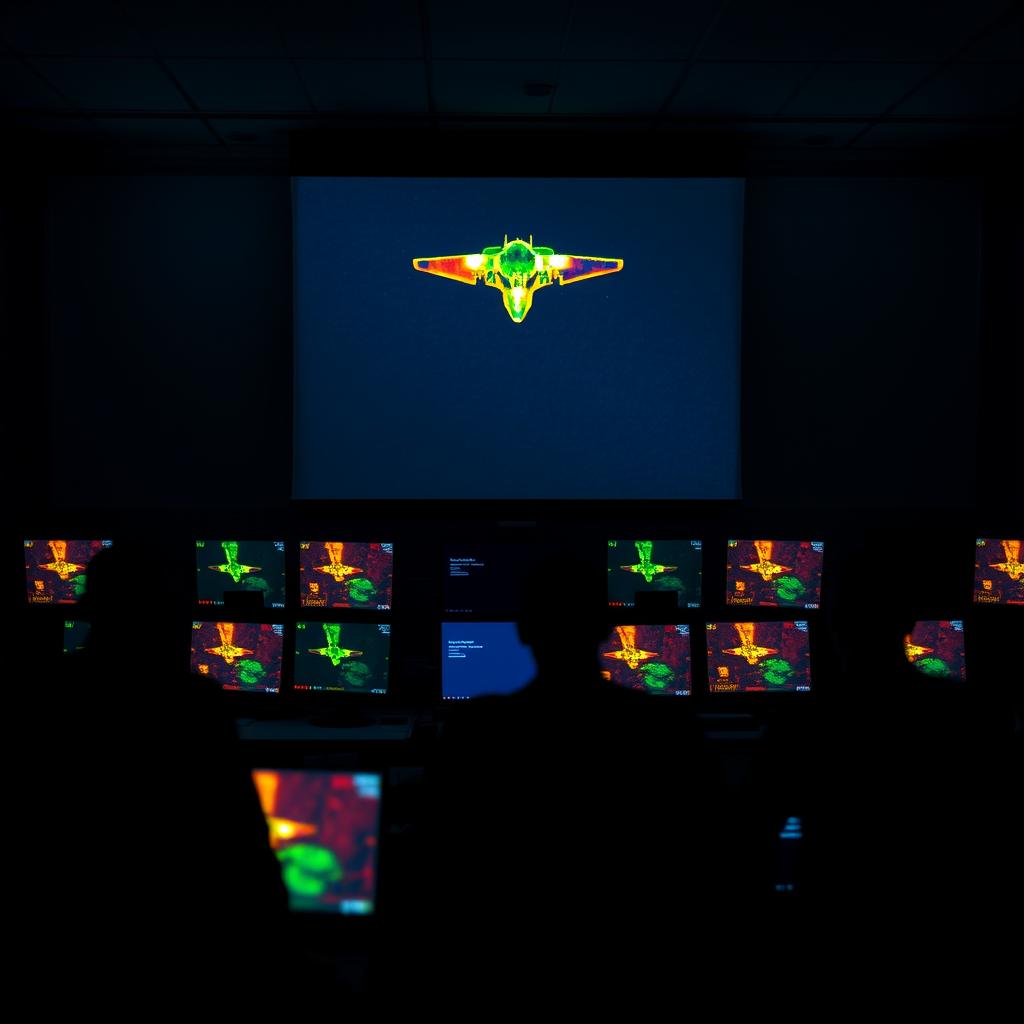
The U.S. Indo-Pacific Command submitted an unresolved unidentified anomalous phenomenon report to the All-domain Anomaly Resolution Office in 2024, consisting of one minute and 39 seconds of infrared sensor footage captured from an unspecified U.S. military platform — and nothing else. The reporting party provided no oral or written description of what was observed, leaving investigators with only the video record.
What the Footage Shows
According to the Department of War's public disclosure, designated DOW-UAP-PR48, the infrared sensor footage runs the full duration of the submission — 99 seconds — and depicts a single area of thermal contrast that remains generally centered within the frame throughout. The sensor appears to track the object or phenomenon, though the disclosure does not specify whether that tracking was automated or operator-directed.
The department was careful to circumscribe the evidentiary weight of its own video description. The disclosure states that the description is "provided for informational purposes only" and that readers "should not interpret any part of this description as reflecting an analytical judgment, investigative conclusion, or factual determination regarding the described event's validity, nature, or significance." That language is consistent with AARO's standard practice of releasing raw case data without prejudging investigative outcomes.
The Missing Witness Account
The absence of any accompanying narrative from the original reporter is a notable documentation gap. Standard military UAP reporting protocols, as outlined in Department of Defense directives, call for observers to provide contextual information alongside sensor data — including platform altitude and speed, environmental conditions, estimated size or distance of the phenomenon, and the observer's own account of the event. None of that information accompanied this submission.
Without a witness statement, analysts at AARO are left to work from imagery alone. Infrared sensor footage, while valuable, presents well-documented interpretive challenges: atmospheric effects, sensor artifacts, background thermal gradients, and platform motion can all produce signatures that appear anomalous without any physical object being present. The absence of corroborating data makes those alternative explanations harder to rule out — and harder to rule in.
The disclosure does not indicate whether AARO has since obtained a witness statement through follow-up, nor does it characterize the case's current investigative status beyond labeling it "unresolved."
Context and Caveats
INDOPACOM covers one of the most operationally dense military theaters in the world, encompassing the Pacific Ocean, the South China Sea, and airspace subject to contested claims by multiple state and non-state actors. UAP reports from the region carry particular strategic weight given the command's proximity to Chinese and North Korean military activity, though this disclosure makes no claim about the origin or nature of what was recorded.
The case was released under the Department of War's UAP public reporting series, a disclosure mechanism that post-dates the 2022 establishment of AARO under the National Defense Authorization Act. The office is statutorily required to maintain a historical record of UAP reports and to provide Congress with periodic unclassified summaries. Individual case releases like DOW-UAP-PR48 represent the unclassified tier of that record.
Reliability caveats apply to this reporting. The source domain — war.gov — carries a trust rating of 30 percent in this publication's internal assessment, reflecting uncertainty about the provenance and completeness of the disclosure rather than a finding of fabrication. The document's formatting and disclaimer language are consistent with other AARO-adjacent releases, but the platform's authenticity has not been independently confirmed through a .mil domain or a named agency spokesperson. Readers should treat the specific details of this case as preliminary pending corroboration from official Defense Department channels.
What is not in dispute is the pattern the case exemplifies: UAP reports submitted to AARO without accompanying witness accounts remain a recurring challenge for investigators, one that the office and its congressional overseers have acknowledged in prior testimony. A sensor track without a human description is a data point, not a case file.